
19 years ago, Aníbal S. Pérez Liñan published the book Presidential Impeachment and the New Political Instability in Latin America. Dr. Pérez Liñan’s phenomenal work hypothesized a new political pattern replacing the traditional model of military coups in Latin America: presidential impeachments. Historically, emerging Latin American politicians fighting for the crown-title of their respected country would enact a military coup to acquire power, but Dr. Pérez Liñan believed the turn of the end of the 20th century presented a new model of acquiring power, without necessitating regime change, in the region via presidential impeachments. In 2026, 19 years after the publication of Dr. Pérez Liñan’s book, there appears to be a new pattern sprouting in Latin America: presidential convictions.
Two recent events have inspired a reflection on Dr. Pérez Liñan’s 2007 book. The first would be the historic conviction of Brazilian President Jair Bolsonaro on September 11th, 2025.[1] The second was sparked by the question presented by a CNN article, “Why Do So Many Latin American Presidents Face Legal Troubles?”. In an unprecedented series of events, rather than facing impeachment during their presidency, Latin American presidents have found serious legal trouble after completing their tenures over the past two decades. A more robust list may be found here, but some of the notable cases are listed below:
- In 2018, former Salvadoran President Antonio Saca was sentenced to ten years in prison becoming the first Salvadoran president convicted of corruption.[2]
- In 2022, Argentine President Cristina Fernández de Kirchner was convicted for a massive corruption scheme in which she awarded public work contracts to allies.[3]
- In 2025, Brazilian President Jair Bolsonaro was the first Brazilian president to be indicted on charges of an attempted coup.[4]
- In 2026, Colombian President Alvaro Uribe was the first Colombian president to be criminally convicted for fraud and bribery.[5]
Put in chronological order, Bolsonaro does not represent a sudden shift, but rather, an emerging judicial pattern across the region. Inspired by recent events, this article ponders: why do legislative institutions fail to remove a Latin American president during their tenure (what happened to the good ol’ impeachment process)? This article argues that sitting executives short-circuit legislative removal by constructing ‘legislative shields’ through patronage that delay conviction until former presidents lose executive power.
Off With Their Heads: Why Not Just Impeach Them?
If Dr. Pérez Liñan’s analysis holds, should impeachment not have been the natural course of unpopular presidents? Surprisingly, there have not been as many successful congressional impeachments (from start to finish) as 2007 may have predicted. While the threats of impeachments still carry the political weight to pressure Latin American presidents to step down, in the past 20 years David De Micheli, Jose T. Sanchez-Gomez, and Kenneth M. Roberts document only four Latin American presidents who were removed from office through successful and complete congressional impeachment proceedings between 2006 and 2022: Fernando Lugo (Paraguay, 2012), Dilma Rousseff (Brazil, 2016), Martín Vizcarra (Peru, 2020), and Pedro Castillo (Peru, 2022).[6]
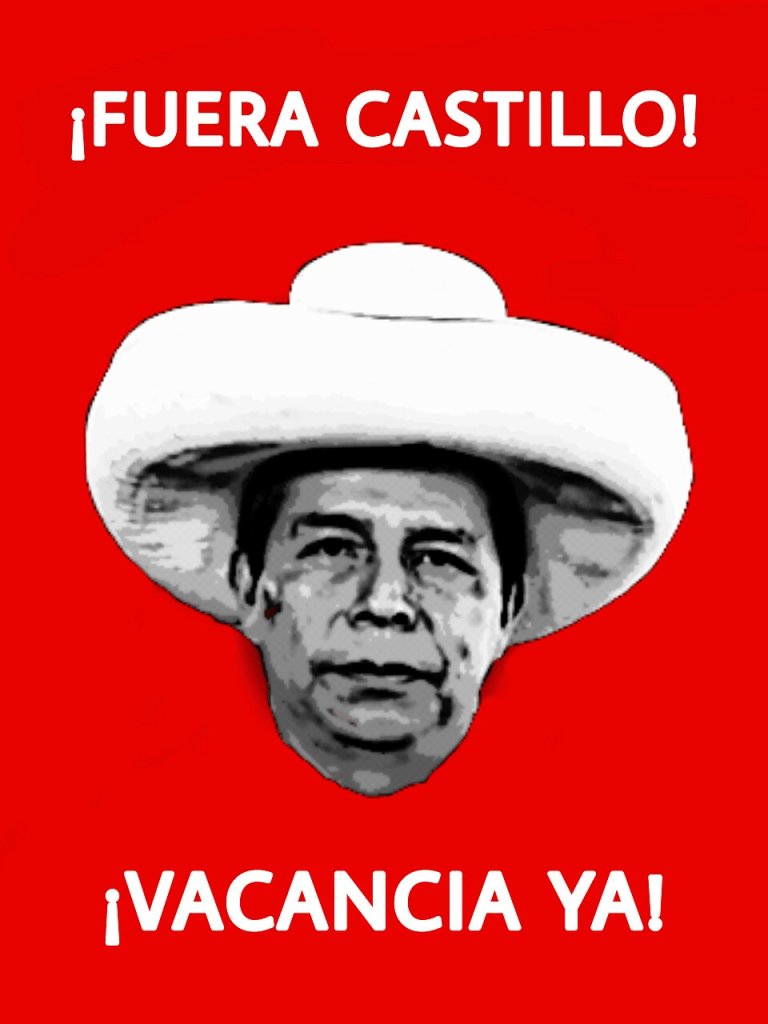
A 2022 poster demanding the removal of Peruvian President Pedro Castillo (Image: Wikimedia Commons).
Meanwhile, there have been far more than four convictions of Latin American presidents, but only after they have left office. As illustrated by the polarizing presidency of Jair Bolsonaro, perhaps, impeachments are easier said in theory than done in practice.
Case Study: Brazilian President Jair Bolsonaro (2019 – 2023)
In Aníbal S. Pérez-Liñán’s book, the 1992 impeachment of Brazilian President Fernando Collor de Mello serves as one of the central cases underpinning his analysis. One may ask, why did the impeachment process that struck down president Collor de Mello in 1992, fail to activate against Jair Bolsonaro in 2023?
The failure of horizontal accountability during the Bolsonaro administration (2019–2023) was not a symptom of institutional incapacity or a lack of legal instruments. Rather, in Brazil’s fragmented Congress with over 30 political parties, these oversight agents are frequently co-opted or paralyzed by the executive’s control over patronage. Steven Levitsky and Lucan Way believe that in regimes experiencing democratic erosion, incumbents distort the political playing field by undermining horizontal accountability (the legislative branch) and politicizing state institutions while keeping the formal democratic architecture in place. According to these political scientists, in this context accountability fails not because of regime breakdown, but because political actors choose strategic non-enforcement, a process where institutions like the legislature remain formally in place but become ineffective due to elite cooptation.[7] The Bolsonaro case illustrates this dynamic: rather than dismantling Brazil’s formal institutions of horizontal accountability, the executive could weaken their effectiveness by cultivating legislative allies whose political interests were tied to continued executive support.
A Legislative Shield: From Samper’s “Co-financing” to Bolsonaro’s “Secret Budget”
To understand why impeachment failed during the Bolsonaro administration, it is necessary to examine the structural logic of a legislative shield as coined by Aníbal Pérez-Liñán. As he theorized, a president’s survival during a corruption crisis is rarely determined by the legal merits of the case alone, but instead it is a function dependent on their ability to mobilize a critical mass of loyalists to block the constitutional threshold for removal via impeachment. This negotiation strategy transforms the legislature from an organ of oversight into a fortress of patronage, a phenomenon vividly illustrated by the 1996 survival of Colombia’s 1994–98 president, Ernesto Samper.
In retrospect, Bolsonaro’s situation resembles less Collor de Mello’s case of 1992 and instead resembles Samper’s case of 1996. That year, Samper faced the “Proceso 8000”, a scandal involving allegations that his campaign was funded and received approximately $3.5 million by the Cali drug cartel. Samper avoided impeachment by building a legislative shield through a strategy of constant negotiation with Congress. A central component of this strategy was the selective distribution of what Pérez-Liñán describes as “co-financing funds”, which was a strategy of distributing discretionary grants for local public works to secure the cooperation of individual legislators.[8] By strategically distributing these resources, Samper ensured that his legislative base remained cohesive, ultimately securing a 111–43 vote in the House of Representatives to close the investigation.[9] In this scenario, we see a legislative shield made impeachment procedurally available, but politically impossible. President Bolsonaro adopted a modernized and even more systematic iteration of this strategy. Facing over 100 impeachment petitions, Bolsonaro gradually abandoned his “anti-establishment” persona and secured the protection of the Centrão, a bloc of amorphous parties defined by their orientation toward patronage and budgetary influence. The primary mechanism for this protection was often referred to as the “orçamento secreto” (secret budget). This mechanism functioned as a vast reserve of public funds that lawmakers utilized at their own discretion, creating a powerful incentive for members of the Chamber of Deputies to remain loyal to the executive in exchange for earmarked resources.[10]
In the institutional mechanics of parliamentary amendments (PAs), a parliamentarian who aligns with the president of Brazil will receive allocated money in the form of money from the secret budget. By receiving this money, the parliamentarian becomes a part of the Centrão bloc of parties oriented toward patronage and budgetary influence to receive funds that they can invest and allocate to the area important to their electoral constituencies, such as infrastructure, public transportation, or health care. Thus, money from the secret budget is then used in turn by parliamentarians to keep their constituents happy and win their own re-elections.
However, fund allocations were not always made in good faith, as local officials too often fabricated healthcare data to siphon resources through the secret budget. Documented abuses range from small rural towns claiming more HIV tests than the city of São Paulo to the municipality of Pedreira reporting, “more than 540,000 tooth extractions” (which would add up to 14 teeth of each resident including toothless newborns).[11] Nevertheless, the secret budget permits parliamentarians to stay in power and not have the incentive to challenge the status quo of amendments through the secret budget. Much like Colombian President Samper’s co-financing funds, by calculating parliamentarians’ access to public grants, the executive successfully reduced the incentives for coalition partners to defect, effectively transforming the Centrão into a cohesive barrier against oversight. By granting Brazilian House Speaker Arthur Lira and other traditional leaders greater influence over the allocation of public funds, Bolsonaro ensured that the gatekeeping power of the legislature was used to consolidate his own immunity rather than enforce accountability.
In both the Samper era in Colombia and the Bolsonaro era in Brazil, the legislature reached a state where checks were suppressed through the systematic distribution of state resources. By turning the national budget into a tool for elite protection, both presidents successfully short-circuited the network of horizontal accountability. However, while this strategy ensures short-term survival, it leaves a profound institutional vacuum. In the Brazilian case, this vacuum was created by a legislature that refused to act effectively and, thus, compelled the Supreme Federal Court (STF) to emerge as a substitute mechanism for defending the constitutional order.
President Bolsonaro is only one case-study among many. Across Latin America, presidential powerbrokers have become increasingly adept at anticipating and neutralizing the mechanisms of accountability identified by Aníbal Pérez-Liñán. Whether through institutional allies, legislative coalitions, or, in Bolsonaro’s case, an “Arthur Lira” willing to shield the executive, presidents have learned to make the traditional impeachment process increasingly difficult to activate. The “good ol’ impeachment process,” in other words, is not what it used to be as presidents have become better at insulating themselves from legislative removal while in office.
Catch-22: What is a Former Latin American President to Do?

Still from Alice in Wonderland (1951), directed by Clyde Geronimi, Wilfred Jackson, and Hamilton Luske. (Image: Pinterest)
What Latin American presidents have proven considerably less adept at, however, is escaping judicial accountability once they leave office.
What is a former Latin American president to do? In their final chapter of their book, Dr. Pérez-Liñán warned of a catch-22 problem facing Latin American presidents who sought to avoid impeachment: if presidents permitted mass protests from civilians and an executive recall, then the said president would appear weak (too small). However, if presidents were to reign down and stop the protests with brute force, they would appear authoritarian (too big) and perhaps expedite their impeachment.
A similar catch-22 emerges from the convictions of former presidents today. If presidents accept the legitimacy of judicial convictions, they risk appearing too small: by submitting to the courts, they potentially diminish their political authority and influence. Yet challenging a judicial decision presents the opposite danger. By rejecting or disregarding the authority of the courts, presidents risk appearing too big, reviving the image of the Latin American strongman who places personal or political power above institutional constraints and, in doing so, risks losing legitimacy both domestically and internationally. The experience of Rafael Correa (2007 – 2017) illustrates the first dilemma. Following his conviction for corruption in Ecuador, he remained in Belgium rather than return to serve his sentence, effectively accepting the practical consequences of the judicial process while continuing to contest its legitimacy.[14] The alternative is perhaps even more consequential and evident in Paraguay under President Raúl Cubas Grau (1998), whose refusal to comply with a Supreme Court ruling concerning a politically influential general contributed to a broader constitutional crisis that ultimately forced him from office.[13]
Conclusion
While complete impeachments (from initiation to final removal) have proven less common than might have been expected two decades ago, judicial convictions of former presidents are becoming more popular. Rather than viewing this development as a cause for pessimism, the growing willingness of courts to hold former presidents accountable can be understood as the emergence of an additional, albeit gradual, instrument in Latin America’s democratic toolbelt. When and how they are used will be left for courts, policymakers and Latin American voters to decide.
Santiago Vasquez is a former MPhil student in Latin American Studies at the University of Oxford.
[1] Ione Wells and Vanessa Buschschlüter, “Jair Bolsonaro Sentenced to 27 Years in Prison for Plotting Brazil Coup,” BBC News, September 11, 2025, https://www.bbc.co.uk/news/articles/c8xrqxk9p4xo.
[2] Reuters, “Former El Salvador President Sentenced to 10 Years in Prison,” September 12, 2018, https://www.reuters.com/article/world/former-el-salvador-president-sentenced-to-10-years-in-prison-idUSKCN1LS3A7/.
[3] Amy Booth, “Argentina’s Cristina Fernández Sentenced to Six Years in $1Bn Fraud Case,” The Guardian, December 6, 2022, https://www.theguardian.com/world/2022/dec/06/cristina-fernandez-de-kirchner-argentina-sentenced-prison-fraud-case.
[4] Wells, Ione, and Vanessa Buschschlüter. 2025. “Jair Bolsonaro Sentenced to 27 Years in Prison for Plotting Brazil Coup.” BBC News, September 11. https://www.bbc.co.uk/news/articles/c8xrqxk9p4xo.
[5] Ottilie Mitchell, “Ex-Colombian President Álvaro Uribe Found Guilty of Witness-Tampering,” BBC News, July 29, 2025, https://www.bbc.com/news/articles/c5ykw9xq8lwo.
[6] David De Micheli, Jose T. Sanchez-Gomez, and Kenneth M. Roberts, “Tenuous Pacts and Multiparty Coalitions: The Politics of Presidential Impeachment in Latin America,” Journal of Latin American Studies 54, no. 2 (2022): 283–311, https://doi.org/10.1017/s0022216x22000219.
[7] Steven Levitsky and Lucan A. Way, Competitive Authoritarianism: Hybrid Regimes After the Cold War (Cambridge: Cambridge University Press, 2010).
[8] Aníbal Pérez-Liñán, Presidential Impeachment and the New Political Instability in Latin America (Cambridge: Cambridge University Press, 2007).
[9] National Drug Strategy Network, “Colombian President Acquitted of Cartel Ties,” News Briefs, Summer 1996, https://www.ndsn.org/summer96/colombia.html.
[10] Sonia Fleury et al., “O sequestro da política: implicações das emendas parlamentares sobre a democracia, o pacto federativo e a saúde pública no Brasil,” Saúde em Debate 49, no. 147 (2025), e10824, https://doi.org/10.1590/2358-2898202514710824I.
[11] Brasil de Fato, “Understand why the so-called ‘secret budget’ is related to illegality and corruption,” October 7, 2022, https://www.brasildefato.com.br/2022/10/07/understand-why-the-so-called-secret-budget-is-related-to-illegality-and-corruption/.
[12] “Ecuador Ex-President Correa Jailed in Absentia for Corruption,” BBC News, April 7, 2020, https://www.bbc.co.uk/news/world-latin-america-52208588.
[13] “World: Americas—Paraguay sealed off after assassination,” BBC News, March 23, 1999, http://news.bbc.co.uk/2/hi/americas/301800.stm.


