

In May 2025, a New York Times investigation and a bestselling book published in Argentina, Hugo Alconada Mon’s Topos, exposed Russian intelligence officers who had spent years living under false Latin American identities. The NYT article, “The Spy Factory,” reconstructed a Brazilian Federal Police counterintelligence investigation into Russia’s reliance on Brazil to construct identities for elite undercover operatives known as “illegals”. In April 2022, the CIA alerted Brazilian authorities to Sergey Cherkasov, a GRU (Russia’s military intelligence agency) officer who had surfaced in the Netherlands under the Brazilian identity Victor Muller Ferreira. His documents, including a birth certificate, appeared genuine, but the Brazilian Federal Police found that although his recorded mother was real, she had never had a child.
Russia and Latin America: geographically distant but linked by intelligence operations (Image: Prensa Libre)
Between 2022 and 2025, Brazilian authorities launched Operation East to uncover more of these “ghosts”: people with legitimate birth certificates but no trace of an actual life in Brazil, who appeared abruptly as adults and rapidly accumulated identity documents. The operation ultimately identified at least nine Russian officers using Brazilian identities.
Alconada Mon’s book tells a parallel story set in Argentina. Artem Dultsev and Anna Dultseva, SVR (Russia’s foreign intelligence service) officers, spent more than a decade in Argentina under the identities of Ludwig Gisch and María Rosa Mayer Muñoz before being arrested in Ljubljana Slovenia in December 2022, following a tip from foreign intelligence service.
Together, these cases identify at least eleven Russian intelligence officers whose clandestine identities were built in Latin America. In both confirmed cases, the Latin American identity appears to have functioned as a platform for constructing non-Russian passports capable of granting reduced-scrutiny access to more strategically valuable regions, chiefly Europe: Cherkasov used his Brazilian cover to pursue an internship at the International Criminal Court in the Netherlands, while the Dultsev/Dultseva couple relocated to Slovenia to operate across the Schengen area on the SVR’s behalf.
This does not establish a regional Russian network, but it provides a basis for testing whether the conditions exploited in Argentina and Brazil recur elsewhere. This article therefore asks whether other Latin American countries combine similar identity-construction opportunities with limited domestic detection capacity. It does not infer Russian presence from these conditions; rather, it identifies countries whose structural characteristics warrant further scrutiny.
The analytical approach is cumulative: no single characteristic is treated as sufficient on its own. The two confirmed cases provide the starting point from which common conditions are identified and operationalised as indicators, and countries are progressively filtered according to whether they reproduce these conditions. The aim is not to predict where Russian illegals are located, but to identify where a similar operation would be comparatively feasible and difficult to detect.
Late Registration Loophole
The Brazilian case points to a specific vulnerability: obtaining a birth certificate after the normal registration period has passed. As The NYT reports, Brazilian law allows late registration based on a declaration, made before two witnesses, that a child was born to at least one Brazilian parent. The loophole is consequential because a birth certificate is the basic credential through which citizenship can be claimed, opening the door to documents making a cover identity credible: passport, driving licence, voter registration.
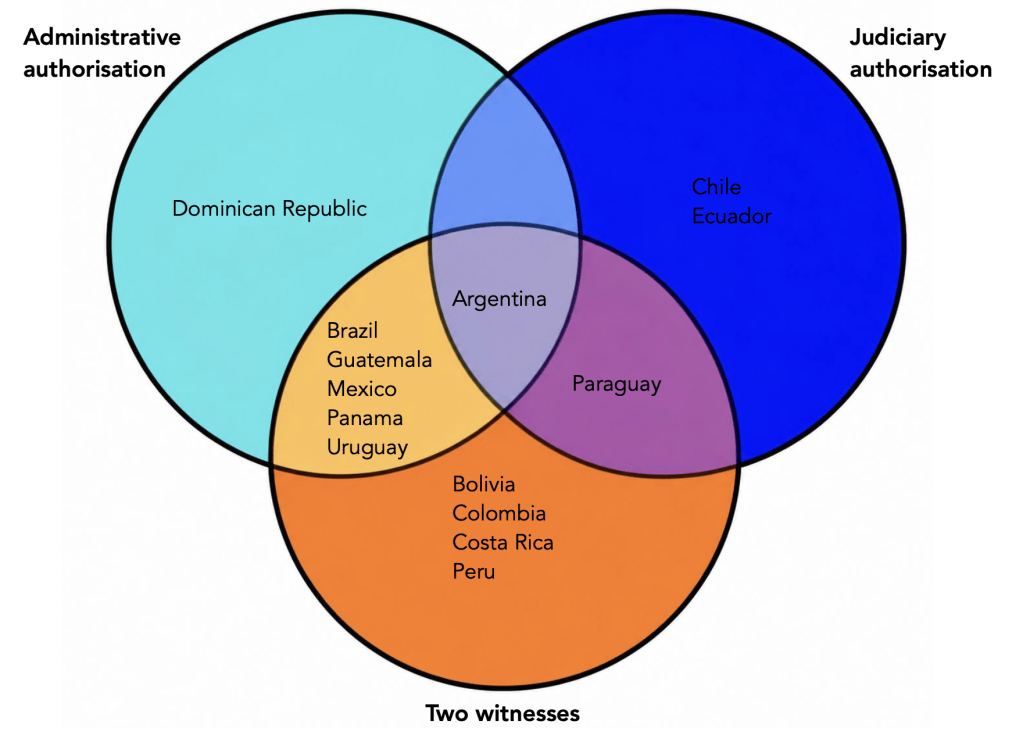
A July 2024 UNICEF report identifies the requirements for late birth registration across twenty Latin American and Caribbean countries. The period after which registration is considered late varies across countries, from as little as 20 days in Uruguay to as long as 12 years in Bolivia. The present analysis concerns the construction of identities for adult intelligence operatives, for whom the relevant procedures would in all cases fall outside the registration period.
Two routes recur: an administrative procedure, a judicial procedure requiring court approval, or both. Argentina and Brazil sit at opposite ends of this spectrum: Brazil’s procedure is purely administrative, requiring two witnesses, while Argentina requires both administrative and judicial authorisation, alongside two witnesses. That successful covers emerged under both systems suggests that formal procedural difficulty is not decisive. Nearly all other countries surveyed also require two witnesses, and most provide at least one route, administrative or judicial, through which late registration can be obtained.
The relevant question is whether authorities can verify the underlying claim before a foundational identity document is issued. A formally demanding procedure may still be vulnerable if the documents and testimony submitted to it cannot be independently checked.
Decentralised registry systems and identity-verification capacity
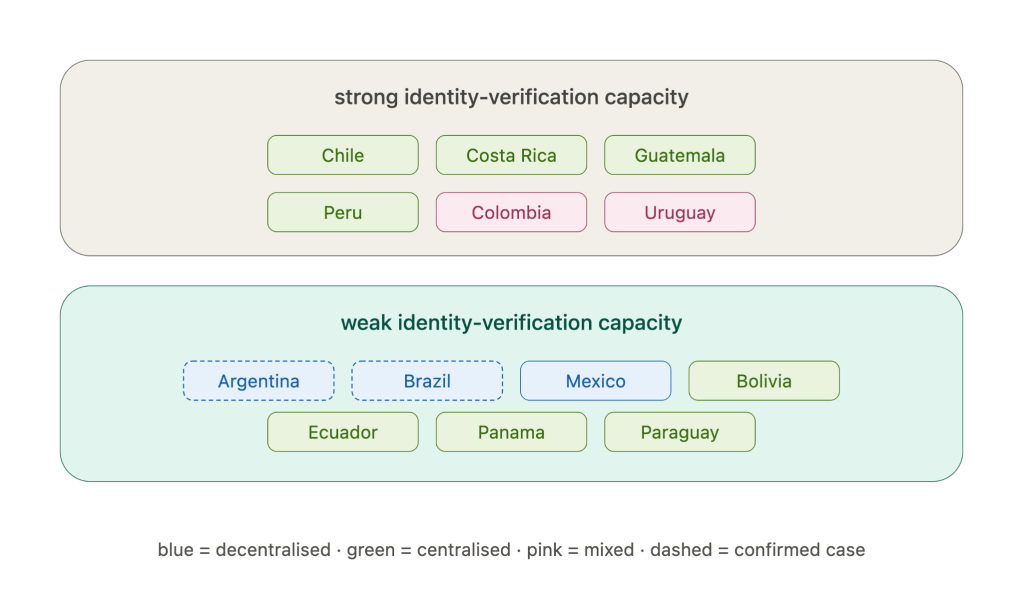
The NYT attributes part of Cherkasov’s success to Brazil’s decentralised civil-registry structure: thousands of local offices operating with limited coordination and oversight. An OAS/UNHCR report similarly classifies Argentina and Mexico as decentralised/federal systems. Yet decentralisation alone cannot explain the two confirmed cases: a centralised registry can be equally vulnerable if its records are poorly digitised or insufficiently cross-checked.
This article assesses four dimensions: cross-check capability (whether registrars can query a national database to detect fabricated identities); institutional autonomy and oversight; digitisation and biometric infrastructure; and the wider state-capacity and corruption environment. These form a broader concept of identity-verification capacity, whose cumulative presence indicates whether a country resembles the environment observed in Argentina and Brazil.
The relevant period is 2000-2015, when the confirmed illegals appear to have constructed their identities. This temporal restriction matters: a country modernised within the last decade may still have been highly vulnerable when an operative originally acquired their documents. The analysis therefore measures historical vulnerability, rather than judging systems solely by their present capabilities.
Argentina’s RENAPER (the National Registry of Persons) operated over fragmented provincial registries and relied heavily on manual, paper-based processes until reforms beginning in 2009. SIBIOS (the Federal System for Biometric Identification for Security), its biometric cross-referencing system, was established in 2011, with the first biometric passport following in 2012. Implementation was gradual: biometric enrolment reached roughly half the population only around 2013-14, and 98 percent by 2018. The old paper “green” DNI remained legally valid until 2017. The reforms therefore represented a transition rather than an immediate closure of the vulnerability.
Brazil’s national civil-registration interconnection system, SIRC (the Civil Registry Information System), was created only in 2014 and rolled out gradually; Rio de Janeiro’s 191 registry offices joined only in 2015. Brazil’s roughly 8,000 notarial cartórios (i.e. registry offices) also lacked a single nationwide coordination layer until the 2022 SERP (Electronic System of Public Registries) reform. During the relevant cover-building period, then, Brazilian registries lacked the interconnection that might have exposed a fabricated identity across jurisdictions.
Mexico provides the first test beyond the two confirmed cases, since it shares Argentina’s and Brazil’s decentralised classification. Although no Russian illegal has been publicly identified there, Mexico’s verification infrastructure displays similar historical weaknesses. Earlier biometric population-register projects, RENAUT (2008-12) and PANAUT (struck down by the Supreme Court in 2022), failed to produce a durable national biometric backbone. Mexico’s biometric CURP (the Unique Population Registry Code) only began piloting in 2025 and became mandatory in 2026. Mexico therefore represents a plausible case of delayed biometric integration facilitating identity construction.
The systems of all three countries also operated inside relatively high-corruption environments during much of 2000–2015. Across the period, the average Corruption Perceptions Index score was 28.3 for Argentina, 33.3 for Mexico, and 37.1 for Brazil, well under the global average. This does not establish that corruption caused Russian operations, but it indicates an environment in which local verification is more vulnerable to manipulation, since underpaid registrars are more susceptible to bribery. These scores were broadly consistent with those found across much of Latin America at the time (except from Chile and Uruguay), rather than indicating that the three countries were regional outliers. Hence, corruption is not treated as a primary explanation for the vulnerabilities identified above, but as a background condition that could increase the scope for manipulation or bribery within already weak verification systems.
Centralisation Is Not Sufficient
Among the thirteen systems in the OAS/UNHCR typology, Bolivia, Chile, Costa Rica, Ecuador, Guatemala, Panama, Paraguay, Peru and the Dominican Republic are classified as centralised (OAS/UNHCR 2020, 26). Uruguay and Colombia are mixed but sufficiently close to the centralised model to be treated similarly here.
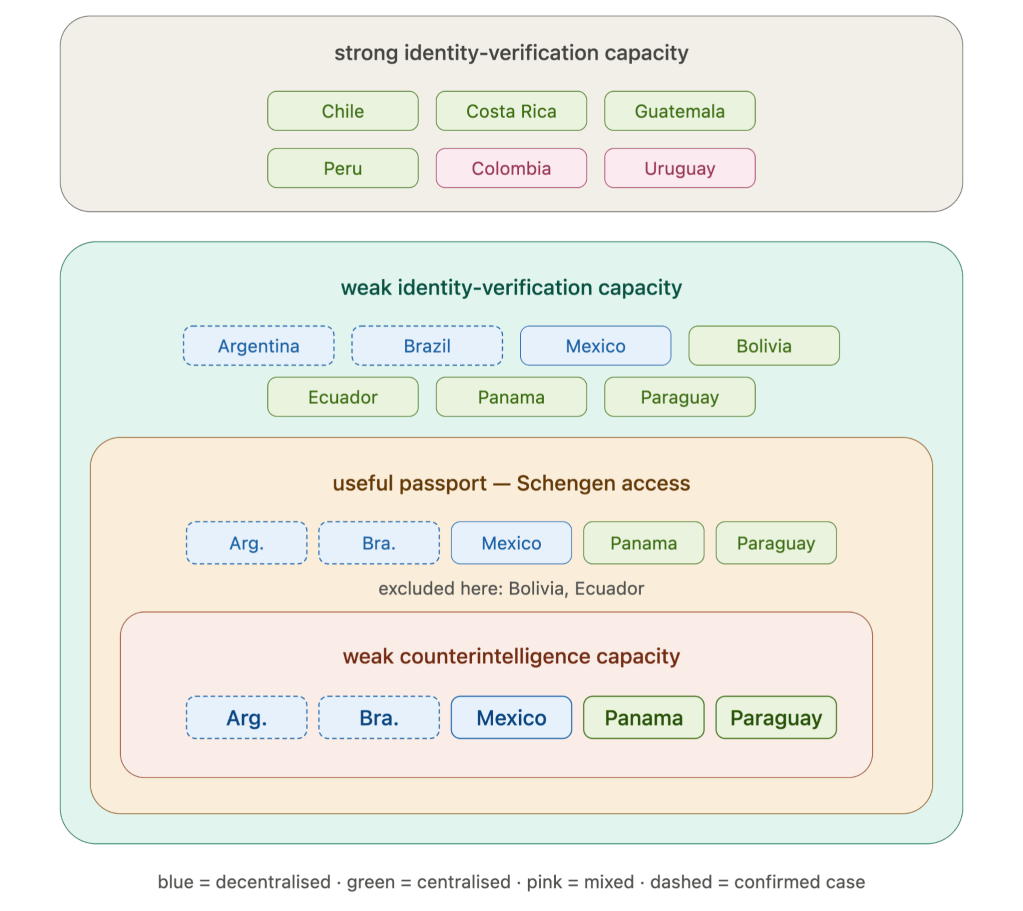
The comparison separates these countries into stronger and weaker groups. Chile, Costa Rica, Guatemala, Peru, Colombia and Uruguay combine centralised registries with substantial biometric investment, digitised records, and comparatively stronger institutional environments. By contrast, Bolivia, Ecuador, Panama and Paraguay had less complete digitisation and largely pre-biometric systems throughout 2000-2015, alongside weaker corruption environments. Their formal centralisation therefore did not necessarily produce effective historical verification.
These cases demonstrate that the categorisation of registry systems is not the vulnerability. Centralised systems can produce the same outcomes as decentralised ones if its records are inaccessible across institutions, if biometric identification is absent, or if local officials retain substantial discretion without effective oversight. The resulting shortlist at this stage is Bolivia, Ecuador, Mexico, Panama and Paraguay.
Passport Utility
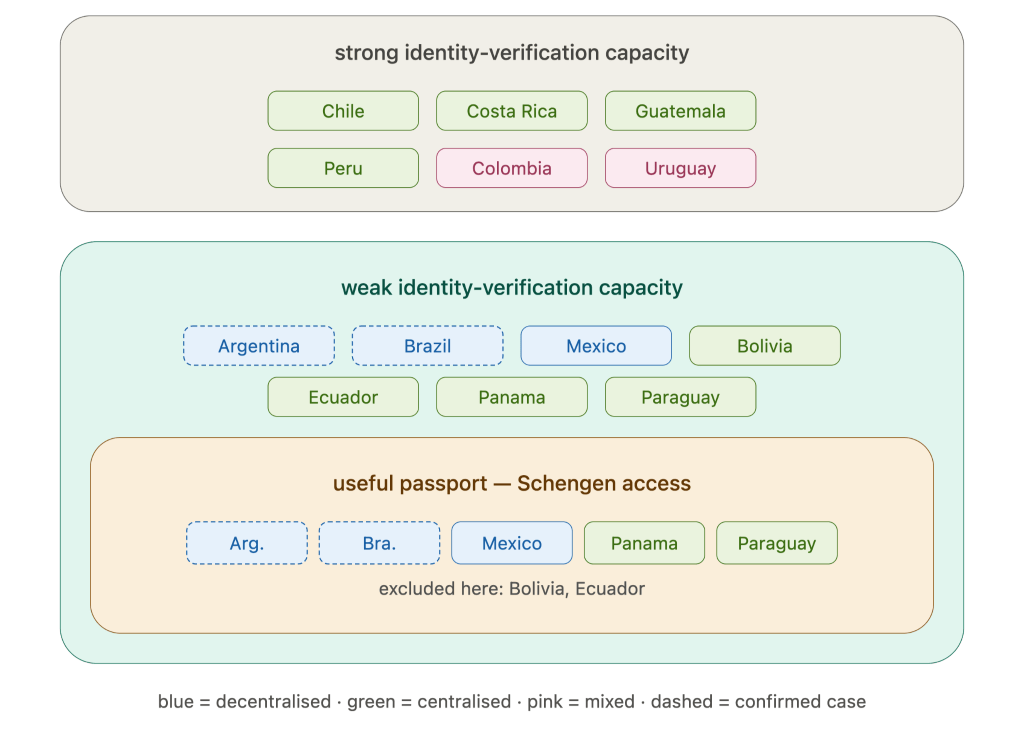
Passport strength measures a different dimension: not the vulnerability of identity construction, but the operational value of a successfully constructed identity. According to The NYT, Russian intelligence services deploy their operatives to Latin America specifically to build a convincing non-Russian cover, before redeploying them as newly minted Latin American nationals to regions such as the United States, Europe, or the Middle East. Cherkasov used his Brazilian identity to obtain an internship at the International Criminal Court in the Netherlands, while the Dultsev/Dultseva couple moved to Slovenia in 2017 after more than a decade in Argentina, operating under their Argentine identities. In both confirmed cases, Europe appears to have been the intended destination, which suggests passport utility should be assessed principally against European mobility.
For an ‘illegal’, the value of a fabricated identity depends partly on what that nationality allows the operative to do after leaving the country in which it was constructed. Among the five shortlisted countries, Bolivia and Ecuador have comparatively weak passports by global standards and lack Schengen visa-free access. Mexico, Panama, and Paraguay, like Argentina and Brazil, offer visa-free short-term access to the Schengen area and broader international mobility. Such access covers short stays rather than residence, but where an individual subsequently qualifies under a destination country’s own immigration rules, it can serve as a plausible first step toward longer-term settlement outside Latin America. Passport utility therefore narrows the shortlist to Mexico, Panama, and Paraguay.
Counterintelligence Capacity
The final dimension is domestic counterintelligence capacity: whether intelligence services can detect a foreign operative living under a fabricated identity. The confirmed cases provide a baseline. Brazilian authorities began investigating the ‘illegals’ programme only after the CIA supplied its 2022 tip. Argentina did not detect the Dultsev/Dultseva couple, who were arrested in Slovenia after a tip from an unnamed foreign intelligence service. In neither case did the host country’s own services independently identify the operatives.
Mexico has no autonomous foreign-intelligence service, with its CNI (the National Intelligence Centre), historically focusing on domestic security and political intelligence. Panama’s principle intelligence body, CSPDN (the National Public Security and Defence Council), is a presidential coordination body; its Department of Counterintelligence sits within the National Police’s Intelligence Directorate, oriented toward organised crime, drug-trafficking, and general security policing. Paraguay had no national intelligence service for the twenty-five years following Alfredo Stroessner’s fall in 1989. Its first National Intelligence System was only created in 2014 to counter domestic and international terrorism and transnational organized crime.
Latin American intelligence services broadly reflect the legacy of Cold War military dictatorships, when they were conceived as instruments of domestic political repression rather than as external-facing services. The association of intelligence institutions with the abuses committed under these regimes, notably through Operation Condor’s continent-wide system of covert repression, has shaped their development during democratic transitions, generating heightened sensitivity around their mandates, oversight and use of resources. Additionally, today, intelligence agencies operate under finite resources and must prioritise threats in response to domestic realities and international pressures. In contemporary Latin America, organised crime, drug trafficking, terrorism and other forms of transnational crime constitute more immediate and visible security priorities than the detection of foreign intelligence officers operating under deep cover. Hence, although these services perform important security functions, their institutional architecture and priorities leave fewer dedicated mechanisms and resources for the long-term identification of a foreign operative whose identity appears legally legitimate and whose activities do not initially resemble conventional criminal threats.
Conclusion
The cumulative analysis does not establish that Russian illegals are operating in Mexico, Panama or Paraguay, nor that these countries have been targeted by Russian secret services. It establishes that these three countries most closely reproduce the combination observed in the confirmed Argentine and Brazilian cases: historically weak identity verification, internationally useful passports, and limited domestic capacity to detect a foreign operative living under a fabricated identity. The conclusion is therefore prospective rather than accusatory: this is a concept of structural vulnerability, not demonstrated Russian penetration. Mexico, Panama and Paraguay should not be treated as countries known to host Russian ‘illegals’. Rather, they are countries where the conditions for constructing a useful foreign identity and avoiding domestic detection appear sufficiently similar to the confirmed cases to justify further counterintelligence scrutiny and international intelligence cooperation.
Bibliography:
Alconada Mon, Hugo. Topos. Edición Planeta, 2025.
Boekle-Giuffrida, Bettina and Harbitz, Mia. “Democratic Governance, Citizenship, and Legal Identity – Linking Theoretical Discussion and Operational Reality.” Inter-American Development Bank (May 2009): 1-41.
Bradley, Jane and Schwirtz, Michael. “The Spy Factory.” The New York Times, May 21, 2025. https://www.nytimes.com/2025/05/21/world/americas/russia-brazil-spies-deep-cover.html?unlocked_article_code=1.2FA.wr9u.tJfdWeeqVMhq&smid=nytcore-ios-share
Conselho Nacional de Justiça. “Sistema Eletrônico dos Registros Públicos (Serp).” Accessed August 10, 2026. https://www.cnj.jus.br/corregedoriacnj/extrajudicial/sistema-eletronico-dos-registros-publicos-serp/
Doladille, Denis; Lara-Salinas, Ana Maria; and Audet, Margaux. “Access to and use of civil registry by migrants in Latin America and the Caribbean.” United Nations Children’s Fund (UNICEF) (July 2024).
El Mostrador. “Presentan prototipo de la cédula de identidad y pasaporte electrónico que regirá a contar de 2013.” El Mostrador, October 13, 2011). https://www.elmostrador.cl/noticias/pais/2011/10/13/presentan-prototipo-de-la-cedula-de-identidad-y-pasaporte-electronico-que-regira-a-contar-de-2013/
Enriquez, Eduardo. “RENAP Guatemala 2026: Direct Access + Civil Registry & DPI Guide.” Living in Guatemala. Updated May 2026. https://livinginguatemala.com/renap
Guerrero Ruíz, Jesús Napoleón. Latin America’s Unguarded Frontier Espionage. Yale Journal of International Affairs, December 7, 2025. https://www.yalejournal.org/publications/latin-americas-unguarded-frontier-espionage
Leite da Silva, Eva Cristina and Schwinden Lehmkuhl, Camila. “O Sistema Nacional De Informações de Registro Civil (SIRC) e o Acesso à Informação.” Revista Analisando em Ciência da Informação no. 4 (2016): 197-217.
Lopez-Solano, Joan and Castañeda, Juan Diego. “‘A promising playground’: IDEMIA and the digital ID infrastructuring in Colombia.” Information, Communication and Society 27, no. 15 (January 2024): 2669-2685.
Maas, Christina. “Mexico Speeds Up Biometric ID Rollout.” Reclaim The Net, April 3, 2026. https://reclaimthenet.org/mexico-speeds-up-biometric-id-rollout
MercoPress. “Paraguay’s First Intelligence Service Created.” MercoPress, December 26, 2014. https://en.mercopress.com/2014/12/26/paraguay-s-first-intelligence-service-created
Miller, David. “Ecuador’s Digital ID: The Chip-Enabled Cedula Explained.” Breaking News Today, January 2026. https://ciad.moa.gov.so/ara/ecuadors-digital-id-the-chipenabled-cedula-explained.html
Ministerio del Interior. “Reseña histórica de Identificación Civil.” Ministerio del Interior, Julio 13, 2023. https://www.gub.uy/ministerio-interior/politicas-y-gestion/resena-historica-identificacion-civil
Opiah, Abigail. “Panama introduces digital ID and wallet for permanent residents.” Biometric Update, 21 October, 2024). https://www.biometricupdate.com/202410/panama-introduces-digital-id-and-wallet-for-permanent-residents
Passport Index. “Explore the world of passports.” Accessed August 10, 2026. https://www.passportindex.org/?
Peña, Arturo. “El documento de identidad en el tiempo.” La Nación, January 19, 2020.
Privacy International. “ID systems analysed: DNIe in Peru.” Privacy International, February 17, 2023. https://privacyinternational.org/case-study/5034/id-systems-analysed-dnie-peru
Red de Seguridad y Defensa de América Latina. “Public Security Index Central America – Panama.” RESDAL (2013): 130-151.
Revollo, Melissa. “Serecí registra de nacimientos, hace saneamientos y biométrico.” Opinión, September 30, 2022. https://www.opinion.com.bo/articulo/cochabamba/sereci-registra-nacimientos-hace-saneamientos-biometrico/20220929224629882101.html
Sito-sucic, Daria. “Russian spies lived a quiet life in Slovenia until they were detained.” Reuters, August 2, 2024. https://www.reuters.com/world/europe/russian-spies-lived-quiet-life-slovenia-until-they-were-detained-2024-08-02/
Transparency International. Corruption Perceptions Index. Accessed August 10, 2026. https://www.transparency.org/en/cpi/2015
Tribunal Supremo de Elecciones. “Documentos de Identificación.” Instituto de Formación y Estudios en Democracia (2010): 7-61.
The World Bank’s Identification for Development (ID4D). “Argentina – ID Case Study: The Evolution of Identification.” World Bank Group (2020): 1-19.
United Nations High Commissioner for Refugees (UNHCR), and Organization of American States (OAS). “Estudio Regional Sobre Inscripción Tardía de Nacimientos, Otorgamiento de Documentos de Nacionalidad y Apátrida.” UNCHR, OAS (December 2020).
Walker, Shaun. “Russian Spies sentenced in Slovenia after pleading guilty.” The Guardian, July 31, 2024. https://www.theguardian.com/world/article/2024/jul/31/russian-spies-sentenced-slovenia-court-prisoner-exchanges

