Before sunrise
It is barely four in the morning when I first hear the bell meant to wake us up. The sun is yet to rise, and the lack of electricity in the town makes it hard to wake up and come to my senses. Less than a minute has gone by when I hear Julián’s voice outside, rushing us. “We need to leave by 4:30,” he says. “We are doing the same path as the women did. We are tracing their steps.”
As I hurry to get ready, I think about the trail I am about to walk. This is the trail that women and children from Río Negro covered before Guatemalan military forces murdered them in 1982. Seventy women and 107 children were killed on the mountain. Their bodies were later found in a mass grave. For more than four decades, this path has been walked as a way of remembering all those that were lost in the Río Negro community—all those who, in one way or another, were killed in the name of development.
At that moment, though, I am not thinking about the language of reports, court cases, or development projects. I am thinking about walking. I am thinking about the flashlight that will show us the way, about trying to follow Julián without falling, and about the women and children who once walked this same route without knowing where they were being taken.
We start in darkness. The sun has not even started to announce its arrival. For half of the way, we maintain our direction with a flashlight. The light catches stones, dry branches, dust, and the backs of people walking ahead of me. Julián goes quickly, with the certainty of someone who has walked this route too many times. I try to keep up, looking down at the ground and trying not to trip. That darkness is the lens through which I imagined Río Negro. After the stories from the day before, it is also how I feel. The mountain is quiet, but it does not feel empty. It feels full of the people who were taken, the people who hid, the people who returned, and the people who have spent decades trying to make sure the dead are not forgotten.
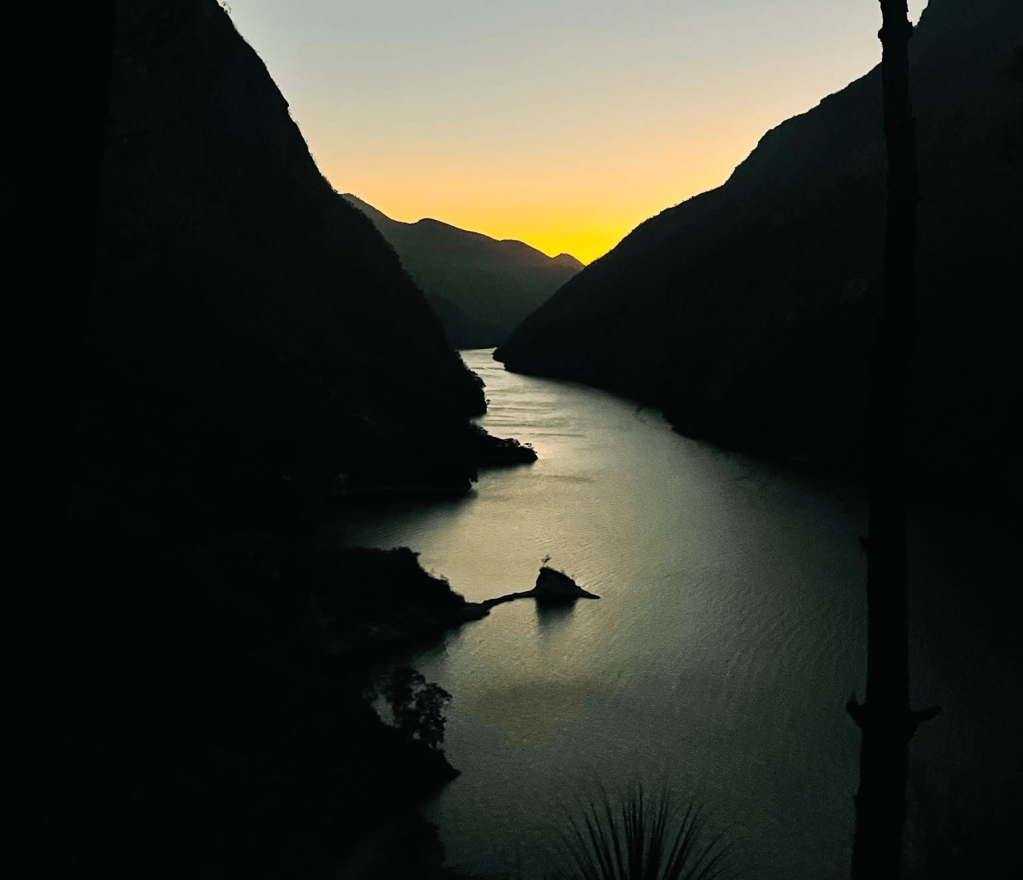
Sunrise at the river
As we keep walking, the day turns slowly into shades of grey. Only the strongest colors can be seen; everything else is still black and white. Then color appears little by little, becoming extremely present when we arrive at the place of the massacre. There is a small structure with four yellow columns, a little deteriorated, and a roof without walls. Inside this almost-house there is an altar with crosses, candles, dead flowers, photographs, and plaques with women’s names. On the short steps leading to the photographs, it reads: “In memory of the 70 women and 107 children who died in the massacre. No more violence against humanity.”
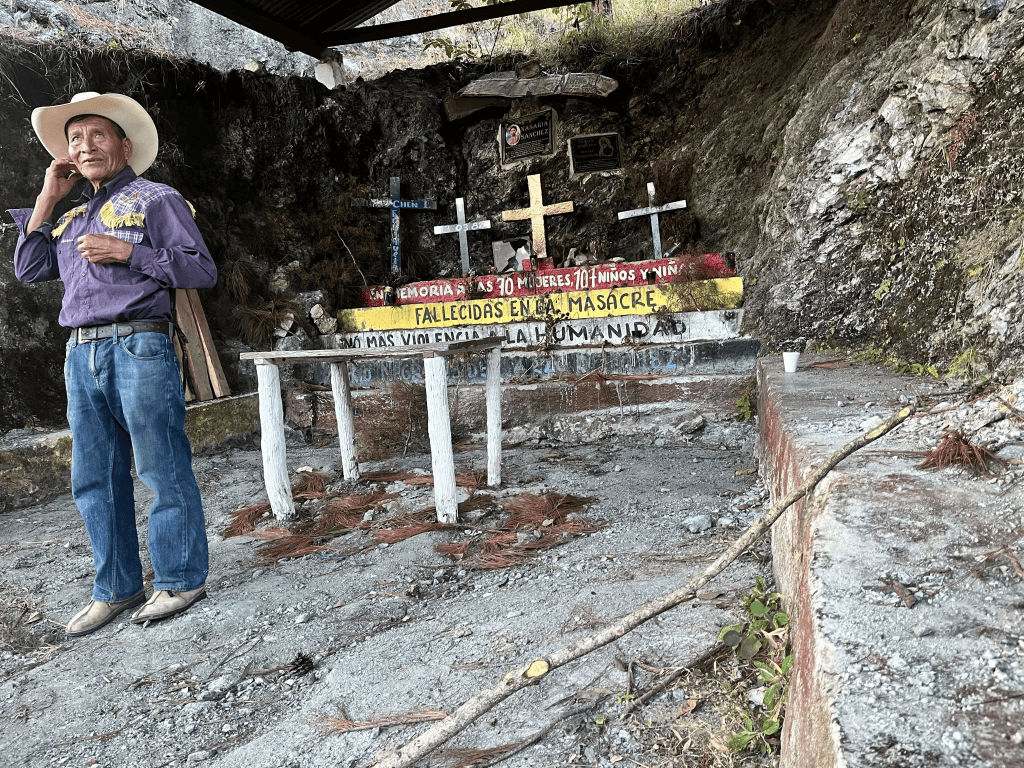
The memorial to the massacre
I do not think I will ever be able to explain what it feels like to enter that place, the place where all these women and children were found without life, piled together. I only know that I felt a cold move through my whole body and my head asking, again and again, what could justify something like this. The answer cannot only be found on the mountain, it is also below it, in the river, in the huge concrete wall we had crossed the day before, and in the word that had made the whole project possible: development.
The dam
What is left of the Río Negro community today sits on the banks of the Chixoy Hydroelectric Plant, deep in the mountains of the Baja Verapaz region in Guatemala. To get there, we had to pass through a checkpoint, climb the huge wall of the dam in a flatbed truck, and then cross the water in a small blue wooden boat called Los Exploradores.
The first time I saw the dam, it looked like the walls built in ancient times to protect empires. Beyond the checkpoint, this enormous structure stood in front of us, making the mountains behind it look even more distant. A sign at the entrance said it was the Chixoy Dam and welcomed us to the towns in the mountains inside. We slowly climbed the wall in a dizzying zigzag, entering the river where the community we were going to is located.
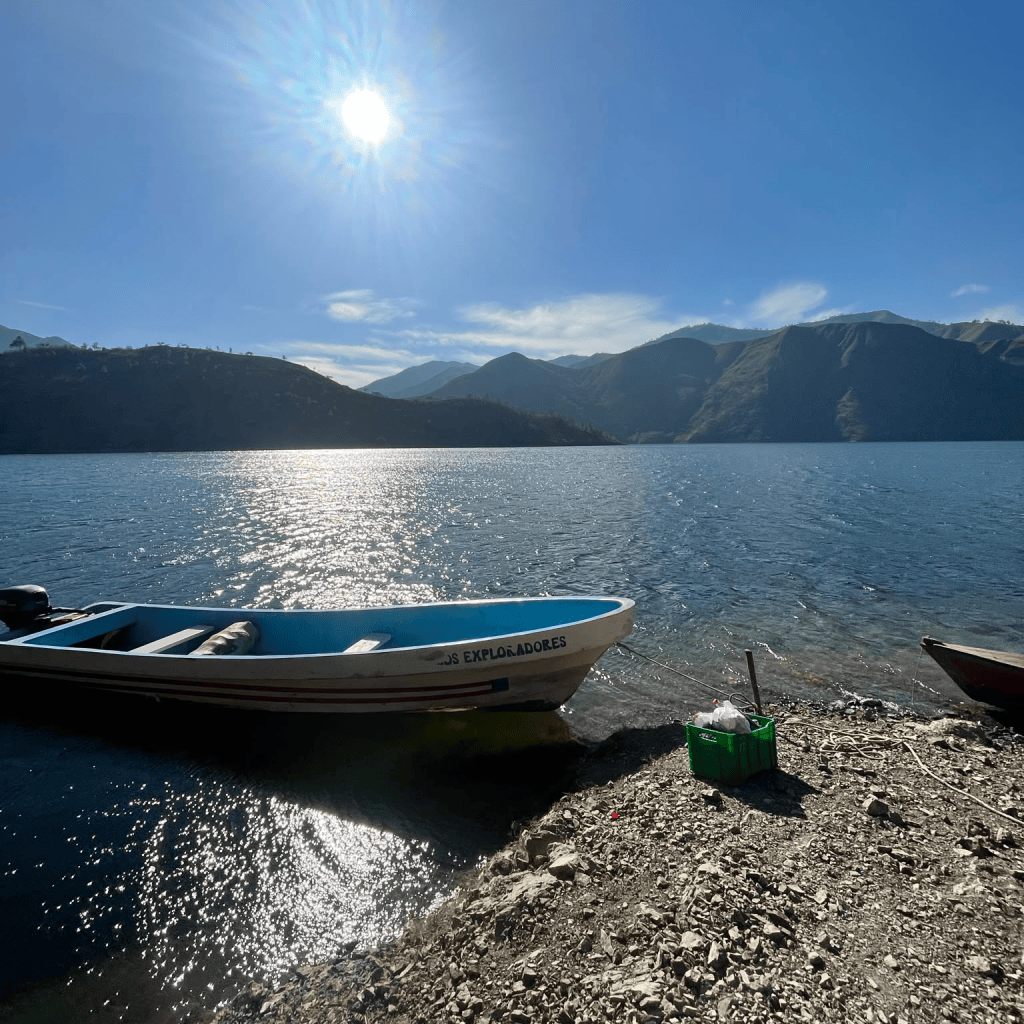
The river connecting the dam to the local community
From the boat, the river seemed endless. The mountains around it gave something to imagine, leaving the feeling of reading a book with an unfinished ending, opening your imagination to an infinity of worlds. But the more I learned about the place, the harder it became to separate the landscape from the project, and the project from the people who had been forced to live through its consequences.
Chixoy was built between the 1970s and 1980s as one of Guatemala’s central development projects. The World Bank described it as “essential to Guatemala’s economic growth and the improvement of the standard of living of its population.” It was expected to generate 300 megawatts of electricity, reduce dependence on imported oil, and support the national energy system.[1] The Inter-American Development Bank approved the Pueblo Viejo–Río Chixoy hydroelectric project in December 1975. In its project documents, the dam was presented as something that would bring positive social effects alongside economic and energy benefits. The promises included employment, technical training, increased access to electricity, and a better future for Guatemala.[2]
It was the kind of project that could be sold through numbers. Three hundred megawatts. US$72 million from the World Bank. A US$121.5 million Inter-American Development Bank (IDB) operation. Loans, forecasts, employment predictions, energy demand, national growth.[3] These numbers helped make Chixoy appear not only desirable, but necessary.
The project eventually cost far more than expected. The World Bank’s Project Completion Report records total financing of approximately US$924.3 million. It records construction and commissioning delays of around three and a half years, cost overruns of roughly 120 percent, and benefits that were “very reduced” compared with what had originally been expected.[4] Those were the numbers that kept returning to me as we crossed the reservoir: 300 megawatts, more than US$900 million, three and a half years of delay, 120 percent in cost overruns.
But none of them explained what I was seeing. They did not explain why the people who lived next to one of Guatemala’s biggest hydroelectric projects had been displaced, why a community so close to a source of energy still lived with limited services, or why survivors carried the history of massacre in their bodies, families, and daily lives. The numbers said Chixoy was big. Río Negro showed me how big its cost had been.
A community in the middle
When we arrived in Río Negro, Sucely pointed to a small wooden cabin on the mountain in front of us. “Centro Histórico de Río Negro,” it said in large white stones in the space beside it, showing that we had reached our destination. After getting off the boat and walking uphill, we were received by Cooper, or Coopertino, a man of average height, dark skin, short matte-black hair, and a mustache that, for some reason, looked even blacker than his hair.
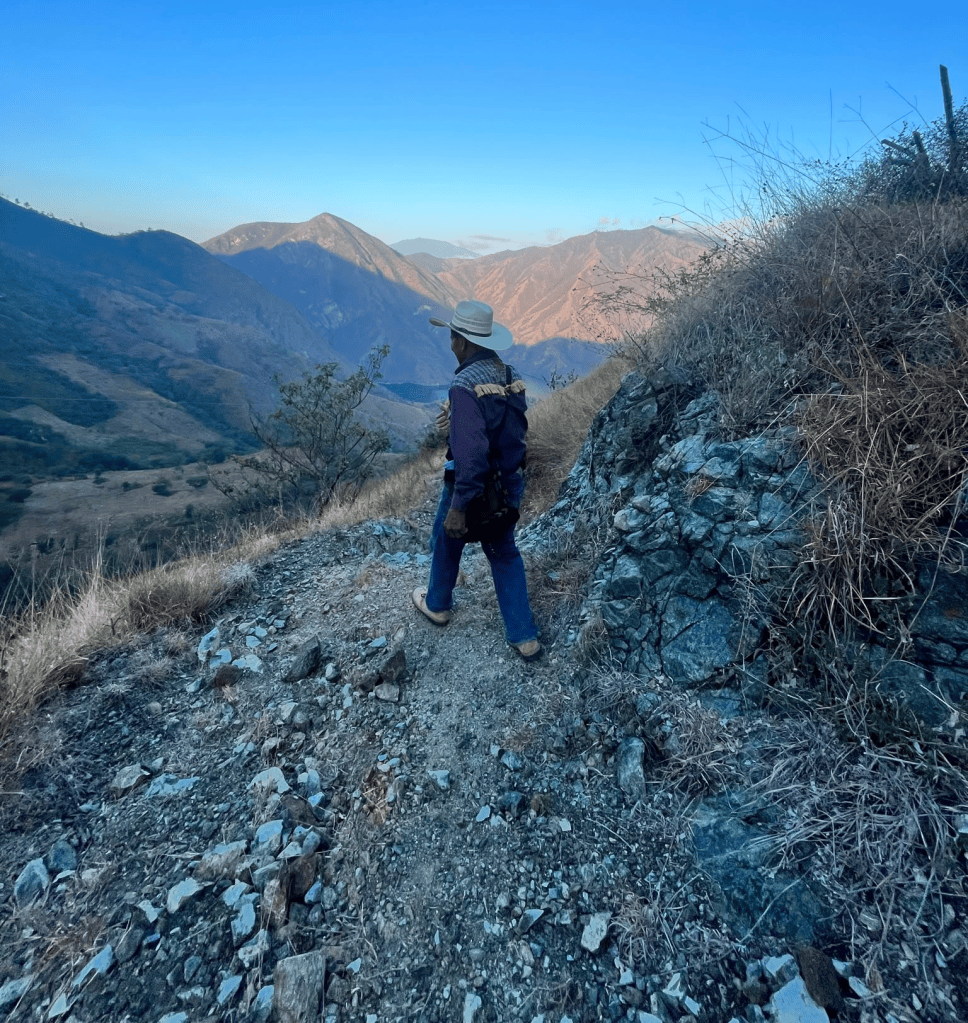
Walking through the mountains to the site of the massacre
“Coopertino, a pleasure,” he said, stretching out his hand before turning to hug Sucely with great enthusiasm. Sucely and Coopertino had known each other for many years. They met during a gathering of families of the disappeared in the early 2000s. Since then, they have worked together on historical-memory projects and on the construction of the Río Negro Historical Memory Centre that we were visiting.
The cozy, wooden cabin quickly became the place where we slowly traced the history of the massacres, building a picture through the different voices and stories of those who remain in Río Negro. Later, sitting in plastic chairs around a fire, Coopertino began by telling us how only he and his mother survived from his family, a family of six people. “I was around nine when the people from INDE first showed up,” he said, referring to the visits carried out by the national electricity institute in the late 1970s. “They would come and ask questions about the community, and we answered without knowing what they were planning.” He makes a brief pause and explains how his family had secured land titles, ensuring that where they lived could not be taken from them— something that was common with land struggles in the country. “My grandparents made sure to purchase the land where they lived and produced,” he said with an explanatory tone. “One day the military came saying that they had to sell their land. When they refused, that is when everything went wrong.”
The land was not simply land. It was where people lived, planted food, fished, raised children, traded, and helped each other. Carlos Chen, another survivor from Río Negro, describes the community before the dam as a place of fertile land along the river, fishing, maize and bean cultivation, fruit trees, collective work, and sacred sites. He also describes how the community’s life was shaped by the river itself: by routes of movement, exchange, food production, and social life that could not simply be replaced with a new house elsewhere. The proposed resettlement offered to them by the government did not offer a viable replacement for that world. Some families refused to sell their land; others left and then returned after seeing that the land and conditions offered through resettlement were not enough to sustain them. People had been asked to give up fertile land by the river and move to places where they could not produce enough food or continue their lives in the same way. The refusal to leave was not simply a refusal of compensation. It was a refusal to accept the disappearance of a way of living.
But Río Negro was not outside Guatemala’s armed conflict. Guerrilla organizations, including the Ejército Guerrillero de los Pobres (EGP), had a presence in the region, emerging in response to the military dictatorship and the repression it brought to many indigenous communities. Having experienced this oppression, some people from the community joined, supported, or became connected to guerrilla organizations. The Comité de Unidad Campesina (CUC) was also active in wider forms of rural and labor organizing. For many people, however, the line between political support, coercion, fear, survival, and accusation was not always clear. In a conflict where armed actors moved through rural communities, neutrality was not something that people could simply choose.[5]
Coopertino explained that, as a child, he did not understand why the military kept saying that Río Negro supported the guerrillas. What he saw was a community trying to remain on its land. What the state saw was something else. The military did not distinguish between armed participation, political sympathy, collective organization, coercion, resistance to displacement, or simply living in a place where guerrilla groups were present. A community defending its land could be called communist. A family refusing to sell could be framed as guerrilla. Returning after an unviable resettlement could become evidence of rebellion. Río Negro was placed in an impossible position. It was caught between the demands of a development project, the realities of the armed conflict, guerrilla presence in the region, and a military state that was willing to treat entire communities as enemies.
The first two members of Coopertino’s family to be killed were his father and older brother. They had been called to a neighboring village by the military, together with twenty-seven other adults. Coopertino explained that the group was told to leave their identity cards with the people who had called them and return in two days to collect them. The journey took almost a day by foot. They walked back home, then returned as instructed.“What they did not know was that they were going to be massacred,” Coopertino said. “They walked back only to be killed.”
I could not stop thinking about how those men walked for almost two days, not knowing that they were being sent into a trap. The military had called them, so they obeyed. They had been told to return for their identity cards, so they returned. It was one of the hardest parts to understand: not because I thought it had not happened, but because I could not stop thinking about the trust placed in something as ordinary as an instruction, a document, an order to come back.
What came next was worse. The military later called the women to a church in the upper part of the mountain. Coopertino was outside the community with his mother at the time. He did not know that his older sister would be killed. The women who had stayed in the community went with their children to the church and found the military waiting.The soldiers lined them up. Some children were separated from the group. More than seventy women and 107 children were taken to the other side of the mountain. Along the way, Coopertino told us, some women were raped and abused. Others, in their desperation, jumped down the mountain trying to escape what they knew was coming. At a small flat area of the mountain, the women and children were killed.
When Coopertino returned, he found his two baby brothers alive in the house. He does not know why they had been left alive. Soon after, they were told what had happened. They had no option but to hide in the mountains as well. “We spent two years hidden in a cave,” he said. “We went through hunger and cold, but we survived.”
I was left without words. I could feel the air entering and leaving my lungs, but it was as if I could not breathe well. Then I understood that feeling as rage and disappointment.
The Official Reports
Before coming to Río Negro, I had read the World Bank’s Project Completion Report on Chixoy. The document talks about costs, delays, energy demand, geological problems, construction failures, and institutional weaknesses. It talks about the tunnel, poor geological knowledge, financial problems, and electricity sales. It says that “INDE and the Government implemented agreed programs of resettlement and erosion-control with substantial delays. The resettlement program was later judged to be flawed in conception.”[6]
Substantial delays. Flawed in conception. I kept thinking about those words after hearing Coopertino’s story. They sounded too small. They did not name the men who walked back to collect their identity cards. They did not name the women and children taken across the mountain. They did not name people who spent two years hiding in caves, hungry and cold.
The report refers to “local insurgency activity” when explaining early delays to the resettlement program.[7] It is important not to erase the armed conflict from Río Negro’s history. Guerrilla groups were active in the region, and some members of the community became involved with them, especially as the military regime became more oppressive. But that context cannot become an explanation for collective punishment. Women and children were not killed because they were combatants. The military’s counterinsurgency approach turned a whole community into an enemy: those who had joined or supported armed movements, those who had been pressured to help, those who had refused to sell land, those who had returned from resettlement, and those who had done none of those things.
The report does not name Río Negro. It does not name the five massacres. It does not name Coopertino’s father, brother, or sister. It does not name the women and children whose names now appear at the memorial. The project’s cost overruns could be calculated. Its delays could be measured. The tunnel could be repaired. The destruction of a community, however, was translated into something technical: resettlement, flawed conception, delay in implementation.
The Inter-American Court later made clear that this was not simply a failed resettlement process. In its 2012 judgment, it found Guatemala internationally responsible for the Río Negro massacres, forced displacement, sexual violence, disappearances, forced child labor, and the destruction of the community’s social and cultural life. It also recognized the particular damage done to the Maya Achí community through the loss of land, cultural practices, sacred sites, and collective forms of life.[8] Survivors were resettled in Pacux, near Rabinal, in conditions that did not replace what they had lost. The Court found that the displacement and resettlement process affected livelihoods, family life, social structures, and the ability to continue agricultural production. Sacred sites, including Los Encuentros, were submerged by the reservoir.
Carlos Chen describes the same loss from inside the community: fertile land below the water, families left on hillsides, and a life connected to the river that could not be recovered by moving people elsewhere.[9]
What remains
Julián carried a laminated piece of paper with him to the memorial. On it were the massacres that his community and neighboring communities had experienced, along with the dates when bodies were exhumed. He had lived through the violence himself. He lost his wife and child in the massacre and survived not only the army but also the guerrilla.
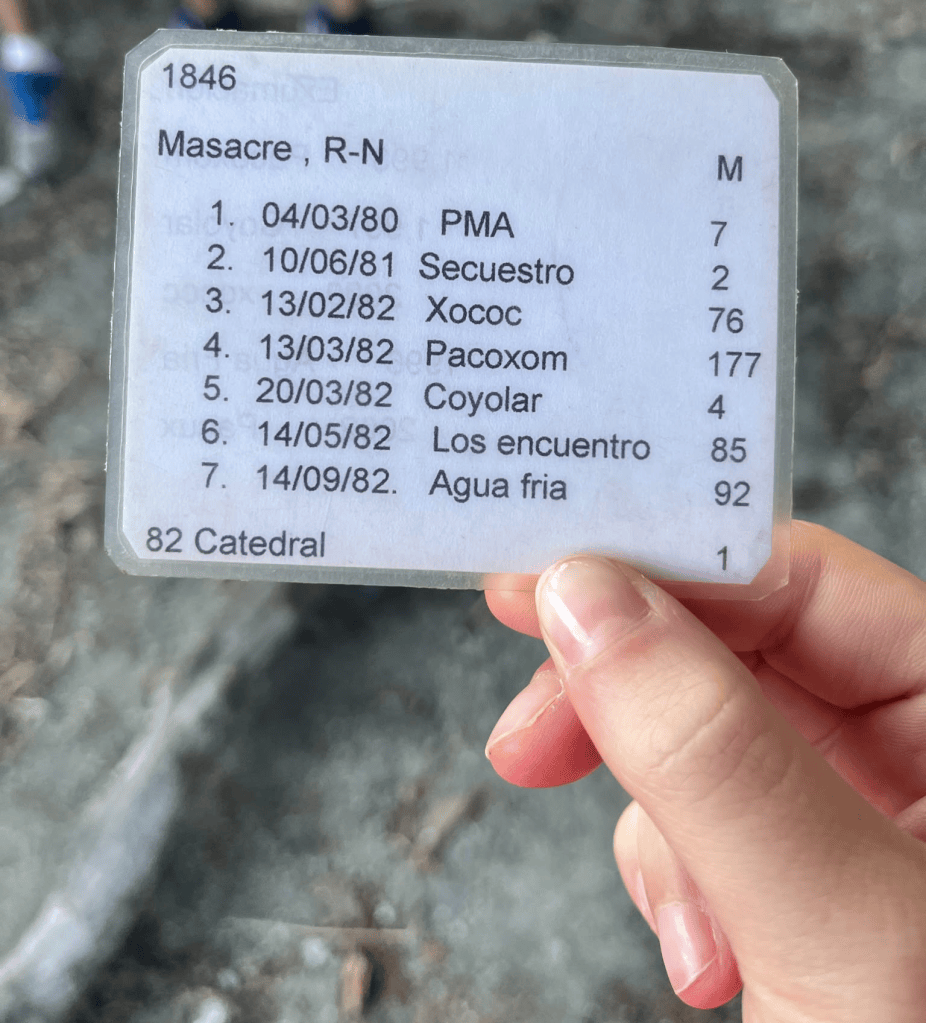
A little card that Julian carries with the names of places and numbers of people killed in some massacres
As we walked down the mountain, I tried to ask him questions. I could not ask much, but I heard how he had written a whole book by hand about everything that happened, a book that he had not been able to publish. He also told me about the daughter he had after his wife died. His daughter was adopted in Sweden after her mother thought Julián was dead and came under pressure from another man. “She was adopted in Sweden,” he said. “Twenty years ago, she sent a letter looking for her biological parents, but her mother did not say anything and did not want to look for her.” He kept talking about his attempts to find his daughter.
“What are you going to do with this information?” I asked myself while Julián spoke. “What use is it to hear this story if you are not going to do anything about it?” With those questions in mind, I told him I would help him look for his daughter. Proudly, I can say that in 2025, almost a year after I left Guatemala, we found her and they were able to meet in Rio Negro, bringing some closure to their lives.
The question of what to do has also been placed before the Guatemalan state, the World Bank, and the IDB. In 2012, seven years after the initial petition was filed by the Association for the Integral Development of the Victims of Violence in the Verapaes (ADIVIMA), the Inter-American Court ordered Guatemala to investigate the massacres, search for and identify disappeared people, provide medical and psychological care, deliver infrastructure and basic services to survivors living in Pacux, strengthen Maya Achí cultural recovery, and create mechanisms for individual and collective reparations.[10]
The Court’s orders recognized something that a cheque alone cannot repair. Río Negro did not only lose individuals. It lost land, homes, cultural practices, sacred places, livelihoods, community, and the possibility of continuing a life that had been built there. Reparations therefore had to mean more than money. They had to include water, housing, health care, land, livelihood, cultural recovery, historical memory, and the ability to rebuild a community.
There have been agreements and some payments. In 2014, a legally binding reparations agreement was signed. In 2015, some families received individual compensation payments, and the agreement included commitments related to land purchases, community development, health and psychological support, historical memory, cultural programs, and environmental mitigation.
A list of commitments, however, is not the same as repair. The delay matters. The uneven implementation matters. The fact that many social measures remain incomplete matters. The Inter-American Court’s continued supervision of compliance shows that the case did not end with its 2012 judgment. Its 2021 compliance-monitoring resolution still addressed obligations that had not been fully carried out.[11]
The World Bank and IDB had both helped finance Chixoy. They sent consultants and missions to assess problems around the project, but neither institution was held legally responsible for the massacres or required to provide reparations in its own name. Instead, when the banks sought to pressure Guatemala to implement the reparations agreement, compliance was connected to US$550 million in new loans to the Guatemalan government.[12]
The contradiction is difficult to ignore. International institutions helped finance a dam whose construction was tied to displacement and massacre. Decades later, rather than themselves paying for the harms connected to the project, they used another cycle of lending to pressure the Guatemalan government to meet reparations obligations. A community harmed in the name of development was left waiting for repair through more development finance.
The dam remains. The water remains. The mountains remain beautiful in a way that is difficult to describe. Chixoy remains a symbol of energy, infrastructure, and national development.But in Río Negro, the numbers that remain are different. There are twenty-nine adults summoned to a neighboring village, only one making it back home. There are five massacres. There are seventy women and 107 children remembered at the mountain memorial. There are people who spent years in caves, hungry and cold. There are sacred sites under the reservoir. There are survivors who remain displaced. There are bodies that took decades to exhume. There are stories written by hand that remain unpublished. There are daughters still being searched for.
It would be too simple to say that Río Negro was only a passive community caught by a dam. The armed conflict was present. Guerrilla groups organized in the region. Some people joined them or supported them; others were caught between fear, coercion, political sympathy, and the need to survive.
But it would be equally wrong to turn this context into an explanation for collective punishment. The military did not only pursue armed combatants. It targeted a community whose people had refused to sell their land, whose collective organization could be called communism, and whose opposition to an unviable resettlement could be treated as guerrilla support. Women and children were not killed because they were combatants. They were killed because the state turned an entire community into an enemy.
This is what makes the question of development more difficult, Chixoy was never just a dam built in the middle of a conflict. It was a development project carried out by a militarized state in which resistance to displacement could be made to look like insurgency. The project’s benefits were narrated nationally—energy, growth, electricity, modernization—but its costs were imposed locally through land loss, militarization, displacement, stigma, hunger, separation, and massacre. For whose development was Chixoy? And at what cost? The answer cannot be found in the 300 megawatts, the loans, or the project reports. It is found in the fertile land now under water, in the communities forced onto unproductive hillsides, in the sacred sites that disappeared, in Coopertino’s family, in Julián’s search for his daughter and them finally meeting after years of searching one another, and in the women and children whose names remain at the memorial.
Río Negro is not an isolated story. Across Latin America, projects presented as national progress have repeatedly transformed local communities into obstacles to be managed, displaced, or criminalized. In Brazil, highways, dams, and extractive projects have been associated with the dispossession of Indigenous and riverine communities, sometimes alongside killings and the disappearance of evidence of earlier violence.[13] In Honduras, opposition to the Agua Zarca hydroelectric project culminated in the assassination of Lenca leader Berta Cáceres.[14] In Panama, the Bayano dam displaced Kuna and Emberá communities whose demands for land, compensation, and recognition later reached the Inter-American Court.[15] These cases are not identical to Río Negro, and they should not be collapsed into a single history. Their forms of violence differ. Yet they raise the same unsettling question: when development is defined from above, whose future is being built, and whose lives can be treated as its cost?
Isabela Linares Uscher is a doctoral candidate at the German Institute for Global and Area Studies (GIGA). She holds an MPhil in Development Studies from the University of Oxford.
[1] The World Bank, World Bank Assists Power Project in Guatemala, News Release (The World Bank, 1978).
[2] Inter-American Development Bank, Proyecto Hidroelectrico Pueblo Viejo Rio Chixoy, Propuesta de Préstamo (1999), https://www.iadb.org/es/proyecto/GU0014.
[3] Ibid.
[4] The World Bank, Project Completion Report: Chixoy Hydroelectric Power Project, PCR no. 10258 (The World Bank, 1991).
[5] Carlos Chen, Historias de Lucha y de Esperanza (ADIVIMA, 2009).
[6] The World Bank, Project Completion Report: Chixoy Hydroelectric Power Project, loc. Introduction, Section 7.
[7] Ibid.
[8] Case of the Río Negro Massacres v Guatemala (Judgment), Series C No 250 (Inter-American Court of Human Rights September 4, 2012), https://www.legal-tools.org/doc/178c3a/pdf/.
[9] Chen, Historias de Lucha y de Esperanza.
[10] Case of the Río Negro Massacres v Guatemala (Judgment).
[11] Masacres de Río Negro Vs. Guatemala: Supervision de Cumplimiento de Sentencia (Corte Interamericana de Derechos Humanos 2021), https://www.corteidh.or.cr/docs/supervisiones/Masc_Rio_Negro_16_02_21.pdf.
[12] llevin, “Chixoy Reparations at Last: Checks Are In,” International Rivers, October 20, 2015, https://www.internationalrivers.org/news/blog-chixoy-reparations-at-last-checks-are-in/.
[13] Comitê da Verdade, 1o Relatório Do Comitê Estadual Da Verdade: O Genocidio Do Povo Waimiri-Atroari, Relatório no. 1 (Comitê Estadual da Verdade, 2012).
[14] Berta Cáceres Case,” Civic Case Tracker – RFK Human Rights, February 14, 2025, https://civicspace-casetracker.rfkhumanrights.org/cases/berta-caceres-case/.
[15] ary Finley-Brook and Curtis Thomas, Treatment of Displaced Indigenous Populations in Two Large Hydro Projects in Panama, 3, no. 2 (2010).

