As part of a government campaign ahead of the country’s December 3rd, 2023 national referendum on the annexation of the 159,500-square-kilometre Essequibo region controlled by neighbouring Guyana, the Venezuelan government released a number of ads featuring the Venezuelan national football team. One of the ads shows a clip of the Venezuelan national team’s third goal in their 3-0 World Cup Qualifying win against Chile while the phrase “One does not mess about with Venezuela. Not when it comes to football, nor when it comes to the Essequibo” appears on screen and the narrator urges the viewer to partake in a national referendum.
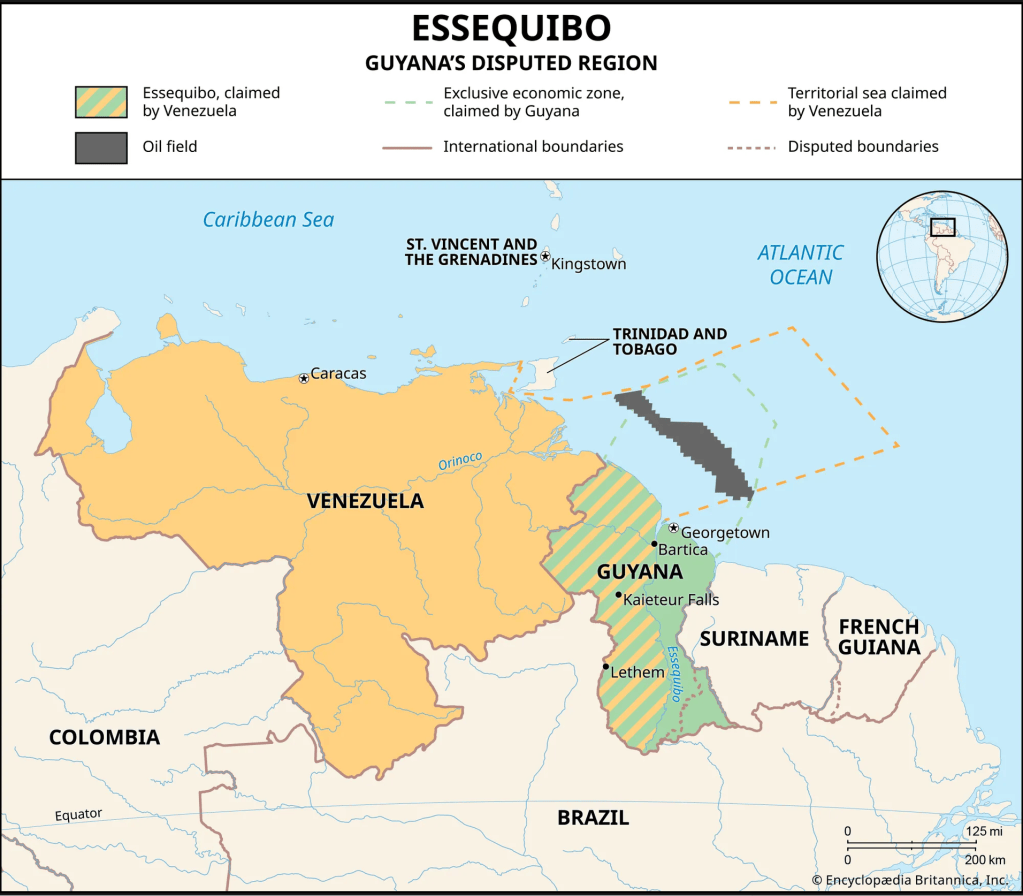
Disputed territory and offshore oil fields along the Venezuela-Guyana border. (Image: Essequibo, Encyclopædia Britannica, Inc./Kenny Chmielewski)
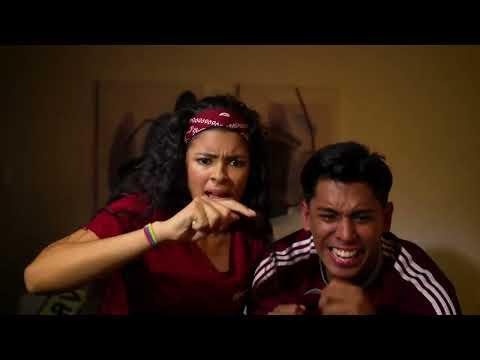
A second ad opens with a group of Venezuelans sitting on a sofa watching the aforementioned Venezuela-Chile match, only this time, the scoreboard shows Venezuela playing against Guyana. Suddenly, another Venezuelan walks into the room while reading about the Essequibo and shouts, “No, we won’t let it be taken from us!” These remarks, alongside a Venezuelan goal, trigger a patriotic frenzy that takes them to the street alongside other Venezuelans dressed in national team colours. Like the first ad, this one ends with a narrator claiming that on the date of the referendum, December 3rd, “we [Venezuelans] all play” before stating that the Essequibo is Venezuelan. The football ads were part of a larger media push by the country’s authoritarian regime to use sports and athletes such as Olympic gold medalist Yulimar Rojas to promote the referendum.

The ads advocating for the annexation of the Essequibo region were not a production of the referendum campaign, but rather the outcome of a longstanding plan by the regime to co-opt football for political gain. By providing the historical, sporting and political context for the ad’s creation, this article aims to illustrate the ways football has been used by the Venezuelan regime to improve its image and promote its political goals.
History of the Venezuela-Guyana border dispute
The area west of the Essequibo River was first contested by Dutch and Spanish explorers in the 17th century. The struggle for the territory continued after the 1648 Treaty of Münster and the British takeover of Guyana from the Dutch after the Napoleonic Wars. Venezuela’s independence from Spain and a gold rush in the 1850s brought local British and Venezuelan authorities into conflict over their jurisdiction in the disputed area. This friction resulted in the 1899 Arbitral Award, which granted Britain most of the territory it claimed west of the Essequibo River. However, in the 1940s, when a posthumous memorandum written by a member of the joint Venezuela-US delegation alleged irregularities, Venezuela officially rejected the award’s validity. This rejection led Britain and Venezuela to sign the 1966 Geneva Agreement, establishing a framework for resolving the dispute with soon-to-be independent Guyana. Unfortunately for the signatories, negotiations failed and the dispute continued into the 21st century.
Recent years have seen these tensions rekindled as foreign companies discovered and exploited offshore oil reserves with the consent of Guyana’s government. This greatly angered the Venezuelans, but only resulted in minor retaliation. It was then that in October 2023, the regime of President Maduro called a consultative referendum on the disputed territory’s future. Beyond its more publicised goals, the referendum also offered a rally-around-the-flag opportunity for Maduro’s unpopular government. To achieve this goal, the government relied on their influence in Venezuelan football to promote the ‘Yes’ side of the referendum. However, to fully understand the cultural context surrounding the situation, it is necessary to examine football’s history in the country.
Venezuela: A recent history of football and politics
For decades, football has influenced Latin American politics. Most infamously, a World Cup qualifier match between Honduras and El Salvador in 1969 exacerbated existing tensions between the two nations, and led to a short-lived armed conflict. Further south, the 1978 FIFA World Cup held in Argentina was used by the host country’s brutal military junta to improve its legitimacy and image among the international community.
Venezuela is no exception, and the last few decades have seen increased political participation in the country’s domestic league and national team program. Despite Venezuela being the only team in the South American Football Confederation (CONMEBOL) to never have qualified for the World Cup, football has exploded in popularity across Venezuelan society since the turn of the millennium. Nicknamed the Vinotinto for its red wine coloured jerseys, the Venezuelan men’s national team has risen from 116th in the FIFA Men’s rankings in July 2001 to as high as number 25 in 2020. While manager Richard Páez and national-team legend Juan Arango contributed to this growth, politics also played a role.
Sporting victories like the legendary Centenariazo of 2004 —where Venezuela defeated Uruguay 3-0 in Montevideo— and the admirable 2006 World Cup Qualifying campaign were followed by massive state investments in the sport. The most notable of these was the $1bn (£500m) spent to host the 2007 Copa América. Hosting the continent’s oldest and most prestigious international competition for the first time was a key moment in Venezuela’s footballing history, and the government of President Hugo Chávez took full advantage of it. This was evident at the opening ceremony when Chávez went onto the field to kick the ball with fellow socialist ally and President of Bolivia Evo Morales, and legendary Argentine footballer Diego Armando Maradona.
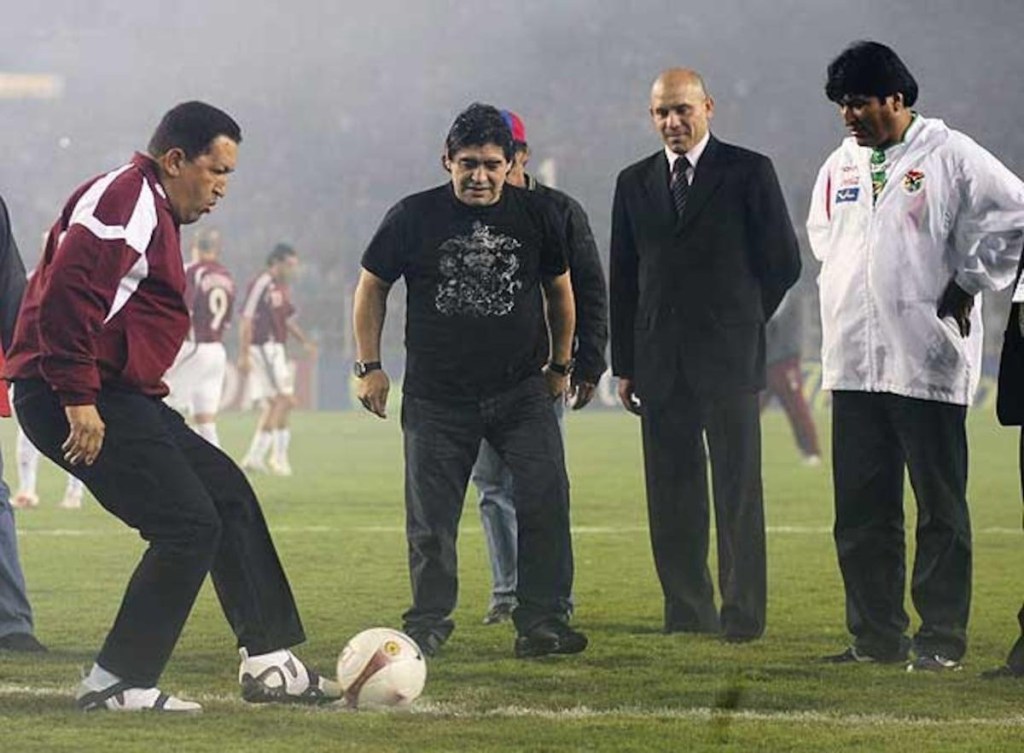
Then Venezuelan President Hugo Chávez (left) kicking the ball, with Diego Maradona (centre, in black t-shirt) and Bolivian President Evo Morales (right, in white) at the inauguration of the 2007 Copa América (Image: El País, 2007).
The success of the 2007 Copa América and the persistent growth of the national team inspired Chávez to continue his involvement in the sport. Frequent visits by Chávez’s “anti-imperialist” ally Maradona and the president’s comments on the fortunes of the national team became commonplace. This tradition of political involvement in Venezuelan football only continued after Chávez’s death and the rise of his hand-picked successor, Nicolás Maduro. Even as the national team’s fortunes declined during the 2018 and 2022 World Cup Qualifier cycles and the country experienced one of the worst humanitarian crises in the history of the Americas, people connected to the Venezuelan government continued to expand their influence on the country’s football ecosystem.
This involvement created an elite of football-connected politicians. Some, like the eccentric governor of the state of Carabobo, Rafael Lacava, are elected politicians who are known to have financed emergent academies and clubs and used them to display political imagery. Meanwhile others, like the chair of the first-division team UCV FC, Alexander Granko Arteaga, hold different connections to Venezuelan government. Granko, for instance, is the chief of Venezuela’s Military Counterintelligence Unit and is under investigation by the UN for his alleged participation in extrajudicial executions. Nevertheless, not all of these government-aligned executives held high-profile roles before their involvement in football. Some, like the Venezuelan Football Federation (FVF) president Jorge Andrés Giménez Ochoa, were barely known outside government circles.
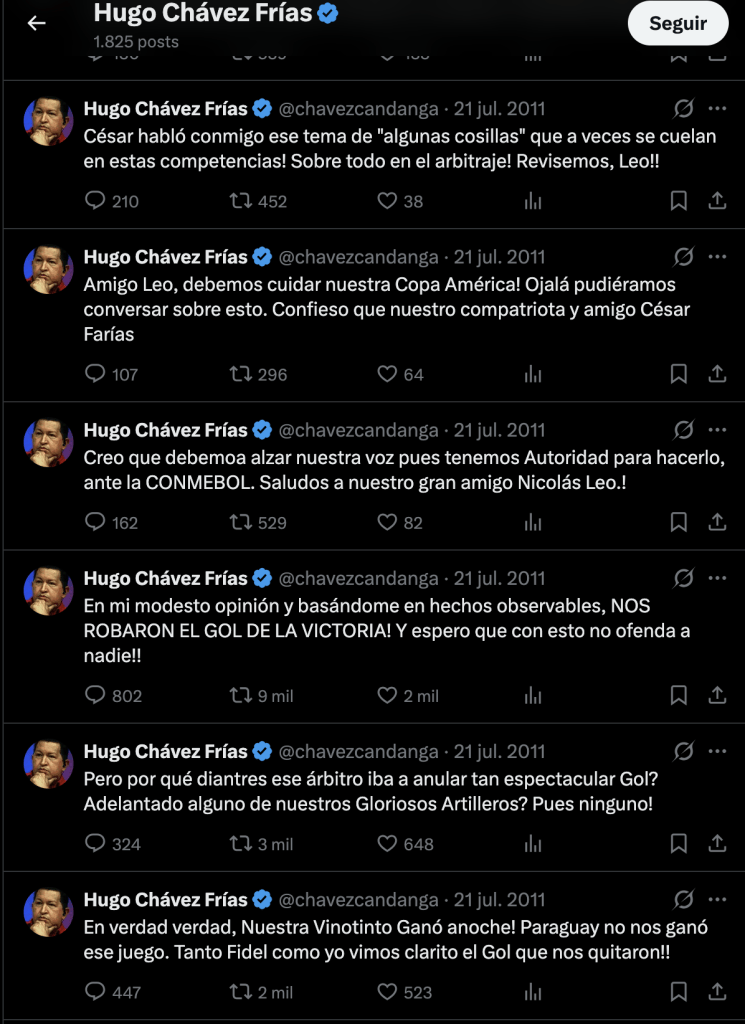
Late Venezuelan President Hugo Chávez issued a number of tweets questioning the referee and CONMEBOL soon after Venezuela’s elimination at the 2011 Copa América. (Image: Screenshot by the author).
Jorge Giménez, the FVF and Politics
After holding stakes in companies including a shrimp farm, clothing stores and an air-conditioning business, Jorge Giménez entered Venezuelan football by becoming owner of the Barquisimeto-based club Deportivo Lara. When a 29-year-old Giménez and his father took over in 2016, Deportivo Lara was an established club that had recently won the Venezuelan first division and possessed a loyal following. However, the real extent of Giménez’s wealth and mysterious business background only became evident as the years dragged on.
The first such instance was in 2020 when Giménez was revealed to have been part of the delegation of then Venezuelan Vice President Delcy Rodríguez that flew to Spain and met with Spanish government officials despite the Vice President’s ban from the Schengen Area. The scandal known as “Delcygate” revealed that Giménez was a close ally of Rodríguez. Giménez’s connections to the then-Vice President were reinforced by a number of text messages discovered by Spanish police in which the then-president of Deportivo Lara called Rodríguez his “boss”.
Giménez’s involvement in the scandal posed no barrier for him to easily win the 2021 election for president of the FVF. His links to the regime were evident from the start. After all, his Vice President, Pedro Infante, was part of the ruling Partido Socialista Unido de Venezuela (PSUV), a sitting member of the Venezuelan congress and a former sports minister under Maduro. Giménez even received public congratulations from the then-Vice President Rodríguez through X (formerly Twitter):
“We congratulate @jandresgimenez, who is taking the helm of Venezuelan football as President of @FVF_Oficial. Venezuela will have a professional voice in the world of international football; a new team will unite all efforts to grow, fuelled by the passion of the fans of this massively popular sport.”
This relationship with Rodríguez also brought Giménez beneficial state contracts. For instance, in 2023 it was revealed that Jorge Giménez owed 1.2 billion dollars to the country’s state oil company PDVSA for oil he had received while the company tried to avoid US sanctions. The president of the FVF is also rumoured to be a big beneficiary of state funds for the acquisition of food destined for the government-distributed “CLAP” sustenance boxes. With a close ally in the FVF presidency, the Maduro regime was free to use the Vinotinto for political goals.
Giménez’s start as FVF president was rocky: after his election, the men’s national team manager resigned, complaining the FVF owed him over a year in unpaid wages. Nevertheless, the federation’s financial troubles seemed to disappear soon after Giménez’s election. Within a few months, the debt owed to the national team’s former manager was repaid and the experienced Argentine manager José Néstor Pékerman was hired with a reported wage of four to six million dollars per year. Giménez’s management also allowed the national team to fly on chartered flights and obtain better training gear. The sources of these funds were undoubtedly state-owned or government-aligned companies. That much was almost admitted by Giménez when, in a public event held alongside then-President Maduro, he called the Venezuelan dictator the “Vinotinto’s silent godfather” and promised Maduro would be the first president to take Venezuela to the FIFA World Cup. It is thus quite evident that the referendum ads were run with the approval of Giménez. From Chávez’s investments in the 2007 Copa América to the use of the national team in the referendum ads in 2023, politicisation of football appears to be a deliberate long-term strategy of the Venezuelan regime.
Conclusion
The final ad to feature imagery from the national football team was a song titled “El sol de Venezuela brilla desde el Esequibo,” meaning “Venezuela’s sun shines from the Essequibo”. Titled after a nationalist phrase adopted by the Venezuelan regime, the music video released alongside the song features several b-roll shots of people wearing the national team colours. Once the votes were counted on election night, the government claimed that over 10 million people had voted and given the government a victory of 95% in all of the questions included in the referendum. The veracity of these results was questioned by opposition politicians; however, it is clear that the referendum campaign and its ads served to divert discussion away from the government’s poor management of the economy. The decision to use the national team in the referendum campaign was not the result of a one-time addition to the political toolbox of the Venezuelan regime; it was the outcome of more than a decade of expansion and consolidation.
While the failure of the Vinotinto to qualify for the 2026 FIFA World Cup resulted in lower levels of interest from the government, the Chavista regime has continued intermittent adoptions of the national team colours. The same is true for the Venezuelan claim on the Essequibo, the intensity of which partially subsided after 2024. Most recently, a now-acting President Rodríguez revived the discussions around the dispute after she visited the Hague to support the Venezuelan claim before the International Court of Justice. To coincide with the visit, several government accounts on social media reposted the “El sol de Venezuela brilla desde el Esequibo” music video. Whether this signals a Rodríguez-led return to the use of the Vinotinto to promote Venezuelan sovereignty over the disputed territory remains unclear. Nevertheless, a recent social media post by the FVF showing Giménez and Rodríguez alongside CONMEBOL president Alejandro Domínguez suggests that the Venezuelan regime’s involvement in the beautiful game will continue for the foreseeable future.
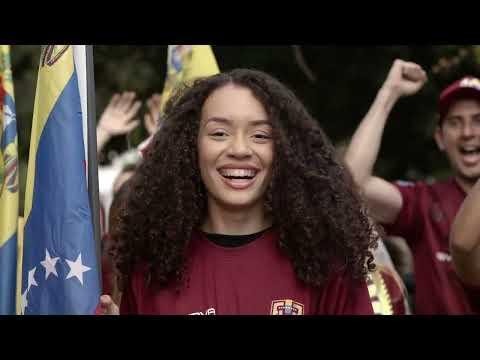
Ad #3.
Rafael Angulo Tirado holds an MSt in Global and Imperial History from Mansfield College, University of Oxford, where he studied nationalism, political rhetoric, and international liberal networks in early twentieth century South America. He also received a B.A. in History with honours at York University, where he was awarded the Dean’s Award for Research Excellence. His research interests include politics, mass media, international relations, and regional integration efforts in Latin America.
Bibliography
Badell Madrid, Rafael, and Héctor Faúndez Ledesma. La reclamación de Venezuela sobre el territorio Esequibo. Serie Estudios 139. Academia de Ciencias Políticas y Sociales, 2023.
Braveboy-wagner, Jacqueline A. The Venezuela-Guyana Border Dispute: Britain’s Colonial Legacy in Latin America. Taylor & Francis Group, 2019. http://ebookcentral.proquest.com/lib/oxford/detail.action?docID=5825550.
Clyde, Keane A. “The Guyana-Venezuela Territorial Controversy: The International Approaches of the Government of Guyana, 1966-1992.” Thesis, Queen Mary University of London, 2002. https://qmro.qmul.ac.uk/xmlui/handle/123456789/28590.
Murray, Shoon. “The ‘Rally-’Round-the-Flag’ Phenomenon and the Diversionary Use of Force.” In Oxford Research Encyclopedia of Politics, edited by Erin Hannah. Oxford University Press, n.d. https://doi.org/10.1093/acrefore/9780190228637.013.518.

