
48 Years of Seeking Latin American Accountability in the United States
United States Special Operations Forces captured Venezuelan leader Nicolás Maduro and his wife, Cilia Flores, on January 3, 2026. At the time, it was among the most contentious international events in recent memory. While some leaders, like U.S. Ambassador to the United Nations Mike Waltz, deemed the mission a “surgical law enforcement operation,” others deemed it a potential violation of international law.
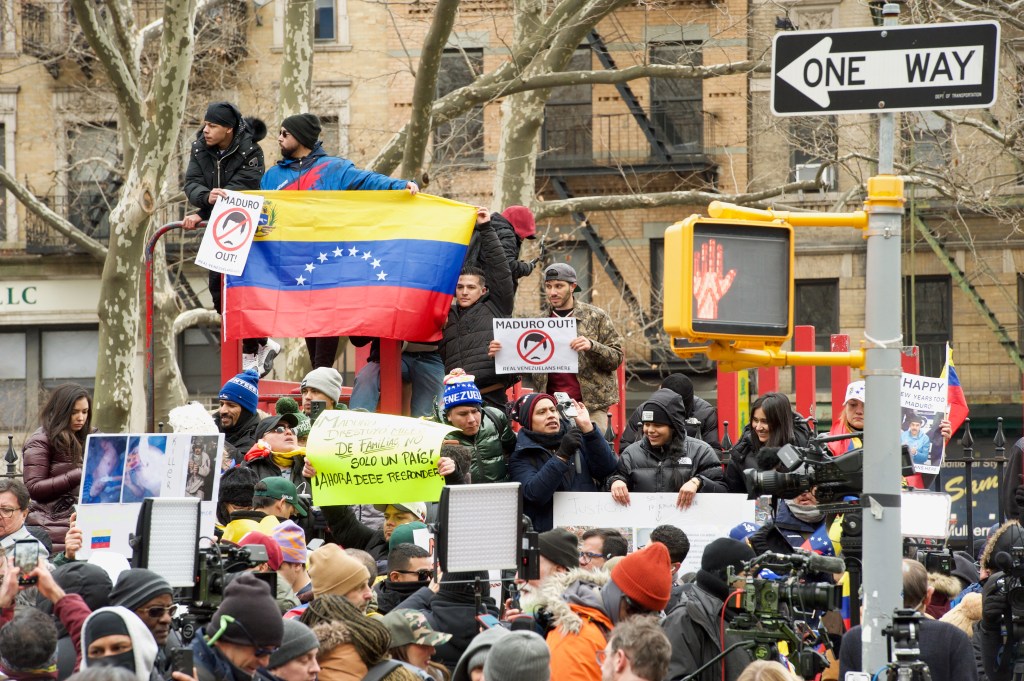
January 5, 2026: A crowd of people and press gather outside the United States District Court in Manhattan for Nicolás Maduro’s arraignment (Image: Wikimedia Commons)
Despite a multitude of reactions, Maduro’s capture and impending trial did not emerge from improvisation. Rather, they belong to a 48-year trajectory in which the U.S. military and judiciary have challenged the assumption that territorial sovereignty shields Latin American strongmen from the American legal system. This paradigm traces to 1978 when the Filártiga family sought legal recourse in the U.S. during General Alfredo Stroessner’s regime in Paraguay and continued in 1990 with the surrender of Panamanian leader Manuel Noriega. Examining these incidents together provides insight as to how U.S. power moved from establishing a sphere of influence in Latin America under the Monroe Doctrine to directly challenging leadership within the region.
Attempted Extraterritorial Justice for a Paraguayan Murder: Nearly a Victory
On March 29, 1976, Joelito Filártiga was forcibly abducted from his home in Asunción, Paraguay, and tortured to death by Americo Peña-Irala, the Inspector General of Police in Asunción at the time. Filártiga’s father, Dr. Joel Filártiga, was a prominent physician and known opponent of General Alfredo Stroessner, Paraguay’s authoritarian leader whose 35-year regime carried out approximately 400 executions and tortured nearly 20,000 people. Dr. Filártiga filed criminal charges in Paraguay, but the state imprisoned his attorney.
In 1978, with no remaining legal recourse in Paraguay, Dr. Filártiga’s daughter moved to the U.S., later seeking political asylum. After learning that her brother’s murderer had overstayed his U.S. visa, Dolly sued Peña-Irala in the Eastern District of New York. The District Court dismissed Filártiga’s complaint on jurisdictional grounds. On June 30, 1980, however, the U.S. Court of Appeals for the Second Circuit held that torture by official authorities violated universal norms of human rights, regardless of nationality.
The decision established that claims alleging violations of universally recognized human rights norms could be adjudicated in U.S. courts under the Alien Tort Statute. Here, unlike the cases that followed, Filártiga v. Peña-Irala did not directly involve the U.S. executive branch of government. A Paraguayan plaintiff invoked the U.S. judiciary to seek redress for a violation that occurred in Paraguay, and the court awarded damages of approximately $10 million to the Filártiga family. The victory was nevertheless incomplete; Peña-Irala was deported prior to the decision and did not pay the sum. The case therefore provided a landmark legal victory but without tangible justice, a tension that unraveled the following decade when U.S. military power brought Manuel Noriega before an American courtroom.
Noriega’s Capture: Converging Executive and Judicial Power
By 1988, Manuel Noriega, Panama’s de facto leader and former U.S. intelligence asset, was indicted in U.S. District Court on 12 counts of drug trafficking, money laundering, and racketeering. When diplomatic pressure to oust him failed, U.S. military leadership designed what became known as Operation Just Cause. President George H.W. Bush declared several operational objectives: “to safeguard the lives of nearly 30,000 U.S. citizens residing in Panama; to protect the integrity of the Panama Canal and 142 U.S. defense sites; to help the Panamanian opposition establish genuine democracy; to neutralize the Panamanian Defense Forces; and, to bring Noriega to justice.”
On December 20, 1989, President Bush gave the order to execute the operation. 23,000 U.S. service members, including approximately 10,000 soldiers already stationed in-country, conventional army paratroopers, and Special Operations Forces, began to invade Panama. Noriega went into hiding for four days before seeking refuge at the Apostolic Nunciature in Panama City on December 24. Diplomatic and psychological tactics were employed to coerce Noriega from his haven, including ironic heavy metal music that Special Operations personnel played at high volume for three days. Monsignor José Sebastián Laboa, the Apostolic Nuncio in Panama City, informed U.S. leadership that should Noriega’s men utilize force to take control of the nunciature, U.S. forces could infiltrate the compound to gain control of Noriega. Despite this permission, acting Secretary of Defense Donald Atwood stipulated that the Vatican would need to publicize that message for top U.S. brass to approve an infiltration.
The U.S. did not need to commit additional resources to detain Noriega, however, as the dictator surrendered to U.S. personnel on January 3, 1990. He was flown to Miami and later convicted of eight counts in District Court. Upon appeal, the U.S. Court of Appeals for the Eleventh Circuit reaffirmed the conviction and the District Court’s jurisdiction. It held that under the longstanding Ker-Frisbie doctrine, the violent manner of Noriega’s foreign apprehension did not exempt him from prosecution in the U.S. once present before the court. Noriega served 17 years in U.S. prison and was later extradited to France in 2010 and Panama in 2011, where he served subsequent sentences until his death from medical complications in 2017.
The U.S. courts’ handling of Noriega’s trial marked a critical development in the relationship between extraterritorial executive action and judicial jurisdiction. If Filártiga v. Peña-Irala indicated that U.S. courts could assert civil jurisdiction over foreign officials, Operation Just Cause and United States v. Noriega tested whether a foreign leader could be apprehended by the U.S. military pursuant to a standing criminal indictment. By separating how the foreign official was apprehended from whether he could be prosecuted, the ruling affirmed that the manner of the defendant’s apprehension did not bar criminal prosecution once he was within U.S. custody. Three decades later, a similar intersection of military targeting and judicial prosecution materialized when Nicolás Maduro was captured and transported to the U.S.
Maduro’s Arrest and U.S. National Security in 2026
Nicolás Maduro became the president of Venezuela in 2013 following the death of Hugo Chávez, who had governed the country since his election in 1998. Maduro’s administration was characterized by economic turmoil, including hyperinflation that peaked at 130,000% in 2018, and disputed elections in both 2018 and 2024. Throughout his tenure, Maduro strengthened Venezuelan ties with Russia, China, and Iran, increasing U.S. security concerns as strategic adversaries gained greater access to the Western Hemisphere.
In March of 2020, the U.S. Department of Justice indicted Maduro and other senior Venezuelan officials on four criminal counts related to narco-terrorism due to their alleged leadership of Cartel de los Soles, a criminal network that cooperated with the Fuerzas Armadas Revolucionarias de Colombia (FARC). The Trump administration placed subsequent pressure on Maduro, including designating Cartel de los Soles as a Foreign Terrorist Organization (FTO) and conducting military strikes against suspected drug trafficking vessels in the Caribbean in 2025, prior to authorizing Operation Absolute Resolve to capture him in January.
The United States v. Maduro trial is scheduled to begin on June 1, 2027, in U.S. District Court for the Southern District of New York. Maduro has pleaded not guilty. The case will again test whether a foreign leader can be prosecuted in the U.S. for alleged crimes after a military operation facilitated his arrest and appearance in court.
The civil judgment in Filártiga v. Peña-Irala, criminal proceedings in United States v. Noriega, and impending trial of United States v. Maduro represent three instances in which U.S. institutions have challenged the impunity of foreign strongmen, increasingly in cases where the leaders’ conduct implicated U.S. interests. Together, they suggest that seeking extraterritorial accountability is not an outlandish response to authoritarianism but instead embedded within contemporary U.S. strategy.
For U.S. policymakers, this carries practical implications. As reflected in the U.S. 2026 National Defense Strategy, securing and defending the Western Hemisphere is a top priority for U.S. national security. Operation Absolute Resolve, while recent, is only one example that illustrates how legal precedent, criminal indictment, and military power may converge as tools of statecraft that the U.S. government can employ to achieve national interests. As decision-makers consider future policymaking and military operations within and beyond the Americas, understanding how U.S. institutions have engaged with foreign governments over the past several decades is critical.
Austin W. Connors is a U.S. Army captain, Lieutenant General (Ret.) James M. Dubik Writing Fellow, and former Fulbright research grantee to Paraguay. He graduated from Duke University with a B.A. in history and Latin American studies. The views expressed are those of the author and do not reflect the position of the U.S. Government, Department of War, or Department of the Army.


