
In 1991, Medellín recorded 7,273 homicides; 34 years later in 2025, there were only 325.
Over the last four years, different levels of the Colombian government apparatus promoted separate strategies to continue the decline in violence and the attendant rise in tourism revenue. On one side stood leadership from the city and the wider department of Antioquia largely from the right-wing Centro Democrático party. In opposition stood President Gustavo Petro (2022-2026) from the left-wing Pacto Histórico party. Both camps accused the other of jeopardizing Medellín’s relative stability often through the lens of ideological confrontation.
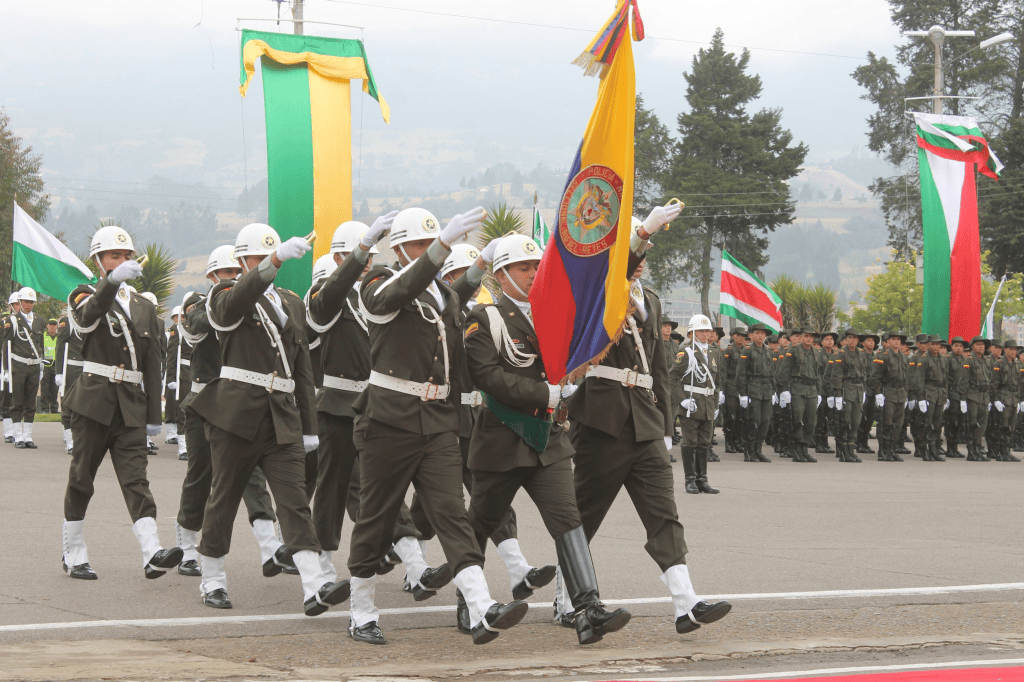
Cadets at Colombia’s Police Academy march in formation (Image: Wikimedia Commons)
While ideological differences shaped the public debate, findings from the author’s fieldwork suggest the central dispute was institutional rather than ideological: Medellín authorities financed much of the city’s security infrastructure while Bogotá retained political control over law enforcement. This structural imbalance is likely to continue generating friction. Consequently, although right-wing populist Abelardo de la Espriella assumed the presidency on 7 August 2026, Colombia’s second-largest city is likely to continue chafing under perceived undue influence from Bogotá unless the process of who directs law enforcement in the city undergoes structural reform.
Battle Over Peace
Petro’s prize policy, Total Peace, had the stated goal of ensuring “our children and grandchildren grow up in a country free of war where dialogue prevails over all forms of violence.” In practice, the national government initiated a series of peace negotiations with the myriad illegal armed groups embedded throughout Colombia. However, with little in the way of signed accords, many on the Colombian right derided the policy as “total failure”.
When Petro brought his flagship idea to Antioquia, there was immediate pushback from Governor Andrés Julián Rendon and deputies in the department’s legislative assembly. In late June 2025, Petro stirred controversy when he hosted an event in Medellín’s downtown. He brought on stage nine leaders of criminal organizations dominating the city’s illicit markets incarcerated in neighboring Itagüí, lauding them as “spokespeople of peace”. Petro claimed that thanks to his negotiations with these capos, homicides had radically decreased in exchange for unspecified “judicial benefits”. Less than a year later, the Attorney General’s office suspended arrest warrants for the kingpins’ associates outside prison walls in an attempt to secure “the complete and definitive abandonment of weapons, of assassinations.”
Medellín’s Mayor Federico Gutiérrez (2016-2019, 2024-present), founder of the small center-right Creemos party that often aligns with right-wing movements, publicly denounced threats by one of the criminal leaders on stage against municipal officials amid ongoing investigations into the kingpin’s family. Gutiérrez, who ran for president in 2022 representing a conservative coalition opposed to Petro, further alleged that Petro’s negotiators leaked information on Medellín’s criminal investigations to the “spokespeople of peace” in an effort “to impede the capture of bosses of criminal structures as soon as the orders for capture are known.”
Gutiérrez’s Secretary for Peace and Human Rights Carlos Arcila similarly characterized the peace talks as dangerous and outside Petro’s legal limits during an interview with the author in April 2026. Arcila argued the kingpins were simply buying time to expand illicit revenue generation. The government, he argued, should break off all talks.
During an interview a few days later, congressman Alirio Uribe Muñoz defended President Petro, arguing that the negotiations were within the president’s legal guardrails. Uribe Muñoz represents Petro’s party, Pacto Histórico,and was a central author of Act 2272 (2022), which constructed the foundation for Total Peace. Critically, this law established two categories for illegal armed groups: those with or without a “political character”. Government negotiators have more leeway with political groups including the option to discuss social reincorporation, political representation, and even special justice mechanisms. Regarding strictly criminal enterprises, the government’s only option is offering lighter punishment if criminals voluntarily “submit to justice”. Uribe Muñoz was adamant that the incarcerated criminal leaders in Itagüí were not political and therefore the peace talks only focused on “submission to justice” as envisioned in Act 2272.
A Subaltern Deal
As Medellín’s leadership openly opposed Petro’s peacemaking attempts in their backyard, they internally crafted a separate policy to pressure criminal groups to eschew violence not based on negotiation but rather selective targeting, according to interviews with Medellín security officials.
A high-ranking official in Medellín’s Security Secretariat explained to the author that the principal explanation for the city’s relative success is a criminal inventory the secretariat created in Gutiérrez’s first term rather than any initiatives from Bogotá. The official, referred to here as Luis, explained that before the comprehensive central deposit for information on the hundreds of criminal groups in Medellín, each law enforcement element focused on their specific crime of responsibility. The homicide unit focused on homicide investigations with the same process applied to units investigating domestic abuse, kidnapping, property crimes, et cetera. A singular database permits units to more easily share intelligence leading to more proactive investigations.
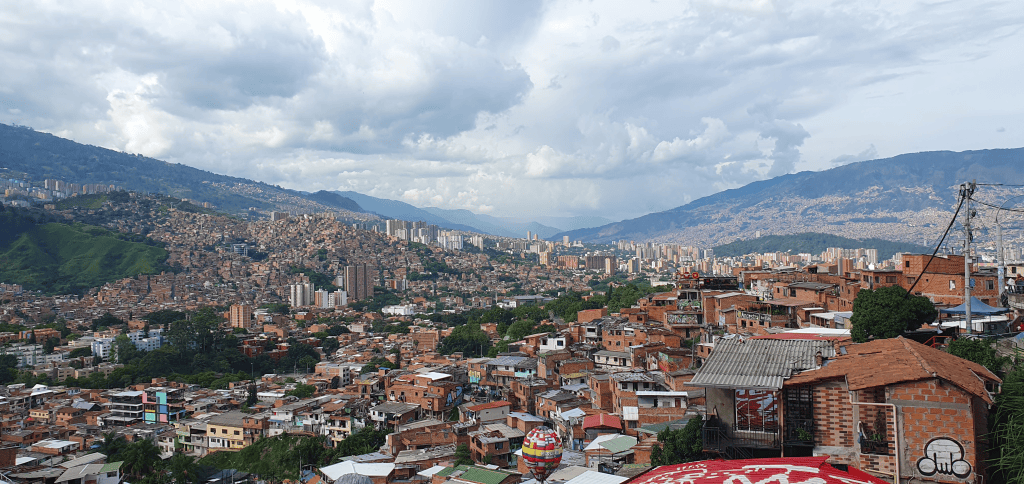
Medellín, Colombia’s second-largest city, was the murder capital of the world in the early 1990s (Image: Wikimedia Commons)
The inventory also allows Medellín’s political leadership to direct attention to the criminal groups deemed most harmful to municipal security regardless of their exact criminal portfolio. If, for example, Criminal Group A is the most detrimental to public security, municipal leadership directs horizontal pressure combining the weight of all law enforcement units.
How then does the city prioritize the various groups? “Violence” was the response. Luis explained how, in tandem with the mayor’s office, the bureaucrats rank groups based on their propensity to commit publicly visible acts of violence. The worst perpetrators receive a coordinated law enforcement response sending a clear message: Medellín does not tolerate violence in the streets.
Instead of formal negotiation, the municipal government’s policy has been to create an implicit agreement. A given criminal group’s territory, cocaine revenue, or extortion rackets do not serve as determining factors for state repression. All forms of criminality pale in importance to public violence. The bargain is straightforward even if never explicitly spelled out. Interviews with contacts in the municipal government demonstrated the city’s security strategy consciously creates incentives for criminal organizations to minimize visible violence. While state actors deny tolerating organized crime, the practical effect appears to be that the groups attracting less public attention face comparatively less coordinated enforcement pressure even if intimately involved in illicit economies.
Luis explained the nature of inter-criminal connections has an immense impact on state actors’ capacity to effectively categorize them. Medellín housed 280 combos, street-level gangs, and approximately 10 larger syndicate-style groups called bandas, Luis articulated. While many groups existed on paper, in reality they aligned either to the Gulf Clan or the Office of Envigado which made categorization and prioritization easier. Luis’s comments suggest the structure of inter-criminal relations has weight. State actors can more practically mold criminal behavior to suit their interests via implicit agreements when criminal structures have already instituted a clearly defined hierarchy.
Scholars and journalists have also pointed to inter-criminal agreements that predate Gutiérrez’s time in office. In 2013, the Gulf Clan and the Office of Envigado reached a “truce” aimed at reducing street-level violence. The resulting “gun pact” persisted, albeit in a fragile and irregular form. Crucially, however, the “ceasefire” did not signal an end to all urban criminal activity. As many scholars have argued, public violence—often measured through homicide statistics—is only one dimension of the complex and multifaceted nature of urban violence. Extortion and protection rackets, for instance, constitute a significant share of criminal organizations’ revenue, yet remain relatively understudied, in part because the available data is limited and incomplete.
Follow the Money
Understanding the root of disagreement between Bogotá and Medellín requires looking toward the institutions responsible for implementing security policy. After discussing the criminal inventory, Luis provided a tour of the city’s state-of-the-art emergency response headquarters stacked with floor-to-ceiling monitors displaying live visual feedback from cameras around the city. A few personnel wore civilian clothing, but the vast majority sported the unmistakable police uniforms with fluorescent trimming. Luis boasted that municipal coffers funded the system to rival those of the largest British and U.S. cities. Earlier comments by Secretary Arcila corroborated the immense fiscal resources the municipal government had invested into seeing every angle via a centralized system.
After returning to Luis’s office he asked, “Did you notice they were all National Police?” The administrative status of the police, he detailed, is a constant source of friction. Typically, the police work hand-in-glove with civilian counterparts in pursuing security objectives, but this is not always the case.
Colombia does not have any subnational law enforcement units which differentiates it from many countries in the Western Hemisphere. Instead, the National Police acts as the sole law enforcement institution. The police force falls within the Ministry of National Defense making the organization structurally akin to a paramilitary. Based on the author’s interviews with Luis and other officials in Medellín’s Security Secretariat, the primary friction point for municipal leadership is that the police’s headquarters resides in Bogotá and ultimately responds to the presidency’s political dictates. Interviewees detailed that while Medellín leaders can invest as much as they wish in support systems for law enforcement, national leadership can overrule any directive from municipal officials which increased in frequency under Petro as Bogotá and Medellín clashed over security policy. Confrontation surrounding Total Peace starkly unveiled the underlying reality that whenever there is a disconnect between fiscal investments and political control, conflict is almost inevitable.
At a base level, the stated goals from Bogotá and Medellín were the same: reduce public violence. Both sets of leaders were willing to deal with criminal organizations to accomplish this objective whether directly or indirectly. The primary distinguishing factor was therefore a question of who had authority to call the shots. At its core the public sparks between Bogotá and Medellín throughout the Petro administration centered on discontent over how to use resources rather than radical disagreement over the intended end state.
What to Expect Under El Tigre
Colombia’s newly minted president Abelardo de la Espriella, ‘El Tigre’, made various promises on the campaign trail that resonated with voters in Antioquia. He assured the public, “I will not negotiate any peace deal. Peace is not negotiated… Peace is imposed by the armed forces and the law.” On the surface there is overlap with the strategy of Medellín’s Security Secretariat and Mayor Gutiérrez: abandon the ill-fated peace talks and focus on targeting malicious actors.
Antioquia’s political elite is likely to prefer the current presidency to that of Petro, but the same fundamental friction points will remain. De la Espriella should not expect full-throated, unconditional approval from Antioquia. Just before inauguration, Senators from Centro Democrático and Pacto Histórico closed ranks in a rare demonstration of unity to block De la Espriella’s candidate from winning the Senate’s presidency. De la Espriella will not likely forget this slight. He has incessantly railed against the “men of always” and explicitly stated his preference for political newcomers over entrenched elite. This style of politics will complicate his relationship with Antioquia’s traditional powerbrokers.
For the next four years, the room in Medellín’s Security Secretariat crammed with monitors and National Police will be a canary in the coal mine. Municipal leaders will likely continue to press their strategy of implicit bargains honed through their criminal inventory hopefully with the National Police on board. However, there is no guarantee. The National Police’s collaboration is contingent. Regardless of whether the relationship is smoother than under Petro, the dilemma persists that local elites lack total control over their fiscal investment in the security realm and cannot entirely ensure implementation of desired policies.
Whether under Petro, de la Espriella, or future presidents, Medellín’s model will continue to face the same institutional constraint: the city finances a substantial share of its security apparatus while ultimate authority over policing remains centralized in Bogotá. Unless Colombia revisits this division of fiscal responsibility and political control, conflicts between national and local governments are likely to persist regardless of ideology.
Cole Penz is a Rising Expert in Latin America Policy for Young Professionals in Foreign Policy. Holds an MPhil in Latin American Studies from the University of Cambridge.


