
For the Caribbean Community (CARICOM), a regional grouping that brings together 15 predominantly Anglophone nations in the Caribbean Basin,[1] intensifying great-power competition presents a paradox. The international institutions and diplomatic principles on which its small states[2] rely are under acute strain,[3] making collective action more necessary than ever. Yet overwhelming power asymmetries, especially pronounced in the contemporary geopolitical landscape,[4] are also exposing divergent views among member governments about how best to exercise strategic autonomy.[5]
These divisions have sharpened under the second Trump administration. Washington’s increasingly assertive approach to the Western Hemisphere, particularly its emphasis on regional security and willingness to act unilaterally, has intensified foreign and security policy disagreements within CARICOM.[6] Guyana and Trinidad and Tobago favour closer strategic alignment with the United States to address security and economic concerns, while Barbados and several other members emphasise international law, multilateral institutions and collective diplomacy as safeguards against external domination qua international hierarchy. Others, including Jamaica, the Bahamas and Belize, seek to maintain engagement with Washington while preserving diplomatic flexibility.[7]
These responses reflect three broad strategies: accommodation, institutional or ‘soft’ balancing and hedging. They are shaped not only by divergent national interests but also by competing conceptions of how small states can best exercise agency[8] to advance those interests.[9] At stake is whether these approaches can be reconciled with CARICOM’s longstanding commitment to strategic autonomy through collective diplomacy.
The Strategic Autonomy Predicament
Since its establishment in 1973, CARICOM has sought to translate small state vulnerabilities into collective diplomatic strength. Except for Haiti, independent since 1804, the bloc’s sovereign members gained independence between the 1960s and 1980s. Foreign policy coordination has been central to that ambition. Despite their limited material capabilities and varying dependence on external partners, the bloc’s 14 sovereign member states have worked to amplify their influence through common positions, international institutions and diplomatic coalitions. After all, they are exposed to challenges that routinely exceed their individual capacities. Pressing issues such as climate change, debt distress, energy insecurity and transnational organised crime illustrate why collective responses are often more effective than national action alone.
Multilateralism has therefore served a practical purpose. Sovereign equality provides a formal basis for participation in international affairs, while international law and institutions offer common reference points for challenging powerful states and negotiating shared rules. Coalition-building can amplify small states’ voices, facilitate agenda-setting and raise the political costs of disregarding their concerns.
These advantages are real but conditional.[10] Formal equality does not guarantee equal influence, and participation in negotiations does not necessarily produce favourable outcomes. Effective multilateral diplomacy requires credible proposals, sustained engagement, capable negotiators and coalitions able to translate negotiated agreements into material changes.[11]
These constraints underscore the importance of strategic autonomy for Caribbean states: their ability to make consequential choices, cooperate with external powers where interests converge and disagree where necessary, while avoiding dependencies that make the costs of dissent prohibitive.
The current international environment makes this objective increasingly difficult. As multilateral institutions come under pressure and major powers adopt more transactional approaches to foreign policy,[12] Caribbean governments face competing incentives. Bilateral engagement may deliver immediate security or economic benefits, while collective diplomacy can help preserve the rules and negotiating mechanisms on which small state influence depends. How governments navigate this tension shapes their respective approaches to exercising strategic autonomy.
The approaches of Barbados and Trinidad and Tobago offer a useful illustration of how Caribbean governments pursue strategic autonomy through different means.
Competing Approaches to Caribbean Agency
Barbados, under Prime Minister Mia Mottley, has championed reform of the international financial architecture through the Bridgetown Initiative.[13] Its approach seeks to change the conditions under which vulnerable countries access development finance, manage debt and respond to climate-related disasters. The underlying proposition is that small states can exercise agency by building coalitions and changing the institutional rules that reproduce their vulnerabilities.
This is more than a normative appeal to multilateralism. Reforming access to finance and the international mechanisms governing debt and climate resilience can produce tangible benefits for countries constrained by high borrowing costs and repeated natural disasters. Institutional reform offers a means of addressing structural disadvantages that bilateral concessions alone cannot resolve.
Trinidad and Tobago, by contrast, has placed greater emphasis on pragmatic bilateral engagement with Washington, particularly on security. Under Prime Minister Kamla Persad-Bissessar, the government has pursued closer cooperation with the United States to address serious security threats to Trinidad and Tobago, particularly from firearms and narcotics trafficking and illicit financial flows.[14] Such cooperation provides access to intelligence, military and law-enforcement capabilities that Trinidad and Tobago would struggle to develop independently.[15]
Both governments seek to exercise national agency, but one prioritises institutional transformation while the other favours bilateral leverage.[16] Barbados seeks to reshape the structural conditions under which small states exercise influence; Trinidad and Tobago prioritises its strategic relationship with Washington to address immediate security concerns, arguing that its participation in US-led security initiatives also advances regional security and prosperity.
Neither approach is sufficient on its own. Multilateral reform requires engagement with powerful states, while bilateral cooperation need not entail abandoning international law or regional solidarity. The difficulty arises when national choices are pursued without sufficiently considering consequences for regional partners.
The ‘Donroe Doctrine’ and the Costs of Fragmentation
These differences become more consequential under the so-called ‘Donroe Doctrine’, US President Donald Trump’s reinterpretation of the 1823 Monroe Doctrine. It reinforces Washington’s claim to hemispheric primacy and its expectation that neighbouring states accommodate its security priorities, which largely inform renewed US attention to the Caribbean region.
The Trump administration’s more assertive hemispheric posture has made this challenge more urgent.[17] For Caribbean governments, the issue is not whether the United States has legitimate security interests. Its geographic proximity, economic weight and longstanding security relationships make it a crucial partner for virtually all CARICOM members, as the Community itself has acknowledged.[18] Rather, the central question is how individual CARICOM member states can advance their bilateral relationships with Washington in pursuit of national interests without undermining regional solidarity or the Community’s capacity for collective diplomatic action.
Trinidad and Tobago’s approach to US security cooperation illustrates the potential divergence between national and regional calculations. Port of Spain may view closer engagement as necessary to address pressing security threats. Other governments may be more concerned about sovereignty, non-interference and the implications of expanded US security operations for the Caribbean’s longstanding aspiration to remain a Zone of Peace. This divergence became particularly evident when Trinidad and Tobago hosted US military exercises amid Washington’s military build-up in the southern Caribbean ahead of the January 2026 operation that captured Nicolás Maduro. Several CARICOM governments had expressed concerns about the US military build-up and its implications for regional peace and stability.[19] These concerns need not preclude security cooperation. They do, however, raise questions about the circumstances in which force is used, the authority under which operations take place and the extent to which regional governments are consulted when their security environment may be affected.
Consistency also matters. Small states have a particular interest in defending sovereignty, territorial integrity and international law because these principles help protect them against coercion.[20] Their credibility in invoking these principles risks being weakened when governments apply them selectively, depending on which state is exercising power.[21]
Yet closer engagement with Washington should not automatically be equated with subordination. Governments confront different threat perceptions, economic circumstances and domestic pressures. Guyana’s territorial dispute with Venezuela and its expanding petroleum sector, for example, create strategic considerations distinct from those of many other CARICOM members.
The danger lies not in alignment itself but in dependence without sufficient safeguards. Bilateral cooperation may deliver immediate security or economic benefits while increasing the future costs of disagreement. If governments become excessively reliant on a powerful partner, their formal sovereignty may remain intact even as their practical freedom of action narrows.
These constraints on national agency can, in turn, undermine CARICOM’s collective leverage. And without effective coordination, individually rational decisions may produce collectively damaging outcomes. External powers may find it easier to negotiate separately with individual governments, weakening the Community’s bargaining position on issues requiring a common stance.
The risk is that CARICOM becomes an arena in which external powers exploit existing divisions rather than a platform through which Caribbean states collectively shape their external relationships.
Managing Difference, Strengthening Collective Agency
What matters, then, is whether regional institutions can effectively manage these differences and safeguard collective interests, potentially generating dividends from closer cooperation.
CARICOM already possesses an institutional foundation for doing so, albeit one that has come under strain. Article 16 of the Revised Treaty of Chaguaramas assigns the bloc’s Council for Foreign and Community Relations (COFCOR) responsibility for coordinating member states’ foreign policies, among other functions.[22]
Three priorities follow:
First, member states should reaffirm core principles governing their external relationships: sovereign equality, respect for international law, peaceful settlement of disputes and what regional security entails. These commitments would not dictate every bilateral decision but could provide common standards for assessing actions with wider regional consequences.
Second, CARICOM should strengthen consultation before members pursue security arrangements affecting neighbouring states. Its purpose should be to identify shared concerns, anticipate diplomatic consequences and preserve opportunities for cooperation. COFCOR is the ideal vehicle, although effective coordination requires sustained high-level political engagement. Heads of government have to be willing to systematically address disagreements before they become sources of diplomatic friction.[23] Furthermore, consultation should respect individual member states’ autonomy while helping to identify wider regional implications and opportunities for cooperation.
Third, member states should distinguish operational security cooperation from broader strategic endorsement. Working with Washington against organised crime need not imply support for every element of US hemispheric policy. Preserving that distinction would allow governments to pursue practical benefits without unnecessarily narrowing their foreign policy options.
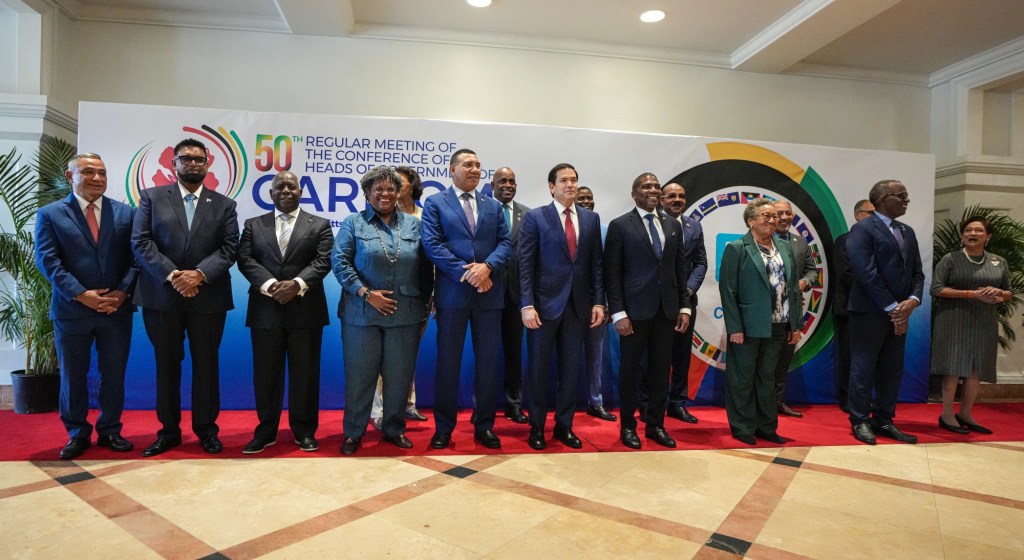
Regional coordination can also advance collective interests. At their February 2026 meeting with US Secretary of State Marco Rubio, CARICOM leaders agreed to pursue a new cooperation framework covering migration, security, trade, investment and development.[24] The high-profile engagement illustrates the scope for collective diplomacy with Washington despite differences among member states.
Notwithstanding, CARICOM ought to continue to diversify its partnerships and pursue reforms to international institutions. But diversification should be guided by a coherent assessment of regional interests,[25] not simply by a desire to balance one external power against another.[26] Moreover, the regional grouping must strengthen its own capabilities in maritime security, intelligence-sharing, financial investigations and efforts to combat drug and arms trafficking. Greater regional capacity would reduce exclusive dependence on external partners and give governments more options when negotiating security arrangements.
Stronger coordination nevertheless offers no guarantee of favourable outcomes. It cannot eliminate material inequalities or reconcile every disagreement. Its value lies in mitigating fragmentation while identifying areas where collective action remains possible.[27]
Beyond the Autonomy Trap
CARICOM’s strategic autonomy trap stems not from divergent national responses to US power alone, but from the difficulty of reconciling them with collective diplomatic interests. This predicament reflects a wider challenge confronting small states: preserving strategic autonomy amid profound power asymmetries.[28] Although they cannot escape great-power influence, they can exercise agency by negotiating the terms of their external relationships and seeking to influence the international conditions under which they exercise strategic choice.
Barbados’ emphasis on multilateral institutional reform and Trinidad and Tobago’s preference for bilateral engagement represent different routes towards that objective. CARICOM’s challenge is to ensure that these approaches reinforce, rather than erode, the collective diplomatic leverage it has painstakingly built over decades.
Its greatest strategic risk is therefore not disagreement itself but the failure to manage it. Member states’ sovereignty gives them the right to pursue different strategies, while their shared vulnerabilities provide compelling reasons to coordinate them where possible.
In an era of intensifying great-power rivalry, CARICOM’s capacity to exercise collective agency will depend on recognising that national autonomy and regional solidarity need not compete. Properly coordinated, they can reinforce one another.
[1] Bardouille, Nand C. “Caribbean Regionalisms in a Comparative-Historical Perspective: The Making of Four Regional Systems.” Canadian Journal of Latin American and Caribbean Studies 43, no. 2 (2018): 171–211. https://doi.org/10.1080/08263663.2018.1456133
[2] Sutton, Paul. “The Concept of Small States in the International Political Economy.” The Round Table: The Commonwealth Journal of International Affairs 100, no. 413 (2011): 141–153. https://doi.org/10.1080/00358533.2011.565625
[3] Bardouille, Nand C. “CARICOM to Focus on Global Risks at UN Summit.” Trinidad and Tobago Guardian, September 17, 2026. https://www.guardian.co.tt/business/caricom-to-focus-on-global-risks-at-un-summit-6.2.2669576.edd7dae90e
[4] ———. “The Caribbean Community’s Divide over U.S. Power.” Latinoamérica21, October 14, 2026. https://latinoamerica21.com/en/the-caribbean-communitys-divide-over-us-power/
[5] ———. “Why the Caribbean Community Bloc’s Diplomatic Nadir Lingers.” In Think Piece Collection for Comparative Policymaking in a Shifting Global Architecture: Approaches from the Caribbean and the Pacific—Managing Sovereign Waters. Inter-American Dialogue, July 21, 2026. https://thedialogue.org/analysis/comparative-policymaking-in-a-shifting-global-architecture-approaches-from-the-caribbean-and-the-pacific-managing-sovereign-waters
[6] ———. “What Is Behind Growing Disunity in the Caribbean Community Bloc?” Latin America Reports, April 28, 2026. https://latinamericareports.com/what-is-behind-growing-disunity-in-the-caribbean-community-bloc/14342/
[7] Lake, David A. Hierarchy in International Relations. Ithaca, NY: Cornell University Press, 2009.
[8] Aryal, Saroj Kumar, and Manish Jung Pulami. “Dispersed Agency in Global Politics: Reimagining Small States in the Post-International Era.” Alternatives: Global, Local, Political 51, no. 4 (2026): 440–461. https://doi.org/10.1177/03043754261418573
[9] Bardouille, Nand C. “CARICOM Has a Great-Power Problem.” IPI Global Observatory, October 9, 2026. https://theglobalobservatory.org/2026/10/caricom-great-power-problem/
[10] Wivel, Anders. “The Grand Strategies of Small States.” In The Oxford Handbook of Grand Strategy, edited by Thierry Balzacq and Ronald R. Krebs, 490–505. Oxford: Oxford University Press, 2021. https://doi.org/10.1093/oxfordhb/9780198840299.013.32
[11] ______. “Why Small States Offer Answers to Important Questions in International Relations: Rethinking Power and Agency.” Small States & Territories 8, no. 1 (2025): 26–29.
[12] Walt, Stephen M. “The Predatory Hegemon: How Trump Wields American Power.” Foreign Affairs, March/April 2026. https://www.foreignaffairs.com/united-states/predatory-hegemon-walt
[13] Bardouille, Pepukaye, and Mahmoud Mohieldin. “Resilience Is a Strategic Investment.” Project Syndicate, August 13, 2025. https://www.project-syndicate.org/commentary/fiscal-frameworks-should-treat-investments-in-resilience-as-productive-by-pepukaye-bardouille-and-mahmoud-mohieldin-2025-08
[14] Persad-Bissessar, Kamla. “Statement at the General Debate of the 81st Session of the United Nations General Assembly.” New York, September 22, 2026. https://gadebate.un.org/en/81/trinidad-and-tobago
[15] U.S. Department of State, Bureau of International Narcotics and Law Enforcement Affairs. “Trinidad and Tobago Summary.” Department of State country programme summary. https://2021-2025.state.gov/bureau-of-international-narcotics-and-law-enforcement-affairs-work-by-country/trinidad-and-tobago-summary/?safe=1
[16] Bardouille, Nand C. “Caribbean Solidarity Fractures on Multilateralism and ‘Donroe Doctrine.’” Geopolitical Monitor, October 2, 2026. https://www.geopoliticalmonitor.com/caricom-donroe-doctrine-barbados-trinidad/
[17] The White House. National Security Strategy of the United States of America. November 2025. https://www.whitehouse.gov/wp-content/uploads/2025/12/2025-National-Security-Strategy.pdf; U.S. Department of Defense. 2026 National Defense Strategy. January 23, 2026. https://media.defense.gov/2026/Jan/23/2003864773/-1/-1/0/2026-NATIONAL-DEFENSESTRATEGY.PDF
[18] Caribbean Community (CARICOM), “Joint Statement on CARICOM’s Engagement with Secretary Rubio,” February 27, 2026, https://caricom.org/joint-statement/
[19] ______. “Statement from the Caribbean Community: Security Build Up in the Region.” October 18, 2025. https://caricom.org/statement-from-the-caribbean-community-security-build-up-in-the-region/; Francis, Kimone. “‘Untenable Situation in Southern Caribbean.’” Jamaica Gleaner, October 26, 2025. https://jamaica-gleaner.com/article/news/20251027/untenable-situation-southern-caribbean
[20] Menon, Sundaresh. “The Rule of Law, the International Legal Order, and the Foreign Policy of Small States.” Asian Journal of International Law 10, no. 1 (2020): 50–67. https://doi.org/10.1017/S2044251319000262
[21] Arajärvi, Noora. “The Core Requirements of the International Rule of Law in the Practice of States.” Hague Journal on the Rule of Law 13 (2021): 173–193. https://doi.org/10.1007/s40803-021-00152-8
[22] Caribbean Community (CARICOM), Revised Treaty of Chaguaramas Establishing the Caribbean Community Including the CARICOM Single Market and Economy, signed July 5, 2001, art. 16, https://caricom.org/wp-content/uploads/Revised-Treaty-of-Chaguramas-Establishing-The-Caribbean-Community-Including-The-CARICOM-Single-Market-and-Economy.pdf
[23] Bardouille, Nand C., and Greg Quinn. “Is CARICOM at a Foreign Policy Turning Point?” Trinidad and Tobago Guardian, February 19, 2026. https://www.guardian.co.tt/business/is-caricom-at-a-foreign-policy-turning-point-6.2.2519181.9fa4994bdb
[24] Caribbean Community (CARICOM), “Communiqué: Fiftieth Regular Meeting of the Conference of Heads of Government of CARICOM, 24–27 February 2026,” March 1, 2026, https://caricom.org/communique-fiftieth-regular-meeting-of-the-conference-of-heads-of-government-of-caricom-24-27-february-2026/
[25] Bardouille, Nand C. “CARICOM’s Inflection Point.” Jamaica Gleaner, February 2, 2026. https://jamaica-gleaner.com/article/commentary/20260203/nand-c-bardouille-caricoms-inflection-point
[26] ———. “Today’s Great-Power Politics and the Caribbean.” Trinidad and Tobago Guardian, July 24, 2025. https://www.guardian.co.tt/article/todays-greatpower-politics-and-the-caribbean-6.2.2361793.feaa52d999
[27] ———. “Can CARICOM Hedge against American Unilateralism?” Jamaica Gleaner, January 19, 2026. https://jamaica-gleaner.com/article/commentary/20260120/nand-c-bardouille-can-caricom-hedge-against-american-unilateralism
[28] See, for example, Lee, Alexander. “How Great Power Rivalry Returned to the Indian Ocean and the Stakes for Australia.” Lowy Institute Policy Brief, July 19, 2026. https://www.lowyinstitute.org/publications/how-great-power-rivalry-returned-to-the-indian-ocean-and-the-stakes-for-australia; Huljak, Jozef. “How Great Power Rivalry Is Fracturing the Pacific Islands Forum.” The Diplomat, September 1, 2026. https://thediplomat.com/2026/09/how-great-power-rivalry-is-fracturing-the-pacific-islands-forum/
___________
Nand C. Bardouille, Ph.D., is a former manager of The Diplomatic Academy of the Caribbean in the Institute of International Relations at The University of the West Indies (The UWI) St. Augustine Campus, Republic of Trinidad and Tobago. He previously served in policy roles at the CARICOM Secretariat, as well as other intergovernmental organizations and institutions. The views expressed here are his own.

