
From the culture war to the erosion of rights
Culture war consists in the aspiration of a particular ideology to acquire an hegemonic position within the political arena. Hegemony goes beyond direct domination and the use of the coercitive force commanded by the state. As Gramsci explains, the aim of this war is to obtain the “spontaneous consent” of the great masses.[1]
The far right uses culture war as a political strategy. It mobilises emotions, discourse and symbols to construct antagonisms, channel social frustration and legitimise political practice against them. Such forms include repression, punishment, discrimination, censorship, persecution and other means of coercion.
Milei and the Culture War
Argentine President Javier Milei constitutes a paradigmatic expression of the far right and illustrates the dynamics of culture war. Milei has recognised in culture war the precondition to legitimise the “ideas of freedom” and prepare the electorate for his radical project.[2] Once in office, he has established “morality as a state policy”, meaning that state decisions are morally based and justified in the name of certain values, such as “the defence of life, freedom and private property” and the so-called “judeo-christian” and Western values.[3]
As part of this war, Milei has explicitly identified “feminism, diversity, inclusion, equity, abortion, ecologism, gender ideology” as antagonists, calling them, “all heads of the same creature, [created] with the main objective to justify the advance of the state through the appropriation and distortion of noble causes.”[4]
Since December 2023, Milei became, in his words, “the mole inside the state”[5], eroding and transforming Argentina’s government from within. He implemented the most important institutional transformation through Decree 70/2023 and Decree 8/2023, which eliminated the former ministries of: Education, Culture, Social Development, Labour, and Women, Gender and Diversity and restructured them into a single Ministry of “Human Capital.” A decision that dismantled the institutional capacity of these agencies, these decrees established a new symbolic and economic hierarchy, followed by an unprecedented budgetary adjustment, to the point of reducing some of the existing programmes to null budget.
The policy domains[6] more dramatically affected by the budgetary assignation during this year, 2026, were education (-48 percent), public health (-53 percent), science (-32 percent), and gender policies (-73 percent), while some state programs have suffered a 100 percent reduction.[7] However glaring these figures may be, this article focuses on the impact of culture war in Argentina’s gender policies under Milei’s government.
The War Against Gender
In four analytical moments, the empirical analysis traces how ideology materialises into concrete institutional transformation, causing the effective erosion of rights.
- The Construction of the Antagonism:
During the 2000s, the recognition of LTGBQ+ rights advanced in many countries, especially in Argentina. Today, however, an aggressive backsliding is threatening those achievements in countries where the far-right is in power. Such countries include Argentina, the United States, Colombia, Ecuador, Chile, and Peru.
The targeted enemy is the construct “gender ideology”. As Laclau explains, the concept acts as an “empty signifier”[8] that, by lacking fixed content, enables the representation of heterogeneous social subjects or demands. Gender ideology therefore includes women, feminism, non-binary and gender-diverse people, LGTBQ+ rights, non-conventional families, women’s rights, sex education, legal and free abortion and contraception, among other gender-related policies and issues.
In Latin America, an anti-gender offensive after the mid 2000s gave rise to conservative movements such as Con Mis Hijos No Te Metas, in Peru (2016) and Escola Sem Partido, in Brazil (2004). In Argentina, the “pro-life movement” – Marcha por la Vida– emerged in 2017 in response to the campaign to legalise abortion. The movement adopted repertoires of action used by the feminist movement and gave them a counter-revolutionary content. Creating the light blue scarf to imitate the iconic green scarves used for the campaign on the legalisation of abortion, they organised protests and marches, cut off streets, and organised vigils outside the Congress around the “defence of life, family, and the decent people.”[9] These dynamics intensified in the context of the congressional debate for the legalisation of abortion in 2018.
The debate constituted a turning point in Argentine politics.[10] The pro-life rhetoric acted as a cohesive element capable of articulating all the spectrum of right and conservative movements. From Peronists, to Democrats and Radicals, from the right to the center-right, all organised to combat the common enemy.
The anti-gender war performs gender – in a broader sense – as antagonic. To quote an illustrative example, in Davos in 2024, Milei lambasted feminism as “a ridiculous and unnatural fight between men and women.”[11] Echoing this, other influential far-right organic intellectuals have portrayed feminism as a “crusade against capitalist society”.[12]
In another example, Milei compared abortion with genocide and blamed feminists for the demographic crisis and economic decline. “The passion for killing children in their mother’s womb,” he remarked, “is costing us a lot in terms of growth.”[13]
- The reframing of Rights, State Interventions and Programmes related with the Antagonists.
Milei’s government treats gender policies as illegitimate, politically biased, and ideologically contrary to the government’s values. They are not considered as a responsibility of the state to address structural inequalities, the existence of which, in fact, the government denies.
In consequence, for instance, the Argentine government, through Justice Minister Mariano Cúneo Libarona, announced its intention to push forward a bill to eliminate the aggravated offense of femicide from the Penal Code, arguing that the recognition of gender-specific violence implies that “women’s lives are worth more than men’s.”[14] Therefore, advocates argue, such policies act as a discriminatory mechanism affecting men, violating the principle of equality before the law.
State agencies addressing gender violence and other forms of discrimination have also been called as ideological, corrupt, and useless. Milei eliminated the Ministry of Women, Gender and Diversity in 2024, alongside with the Subsecretariat of Gender Violence and the National Institute against Discrimination, Xenophobia and Racism (INADI). The latter he described as a “cash machine” to take money out of the state.[15] Delegitimation therefore has been used to justify the dismantling of state agencies.
- Translation into Institutional Transformation
The anti-gender agenda has impacted international affairs. Argentina’s legacy in the defence of human rights is now experiencing significant backsliding. In November 2024, Argentina was the only member of the United Nations to vote against a resolution aimed at preventing violence against women.[16] In August 2026, the country joined the Geneva Consensus Declaration, a conservative coalition established in 2020 by the far-right populists Donald Trump and Jair Bolsonaro to penalise abortion. The decision was justified on the grounds of “the protection of human life and the family as a natural and fundamental element of society.” [17]
Following this conservative ideology, according to Amnesty International Argentina, at least thirteen programmes aimed at preventing and addressing gender-based violence were eliminated in 2025, an estimated cut exceeding ARS 6 billion (approximately USD 4.3 million).[18] Among eliminated programs was Programa Acercar Derechos (PAD) which provided judicial advice to 59,032 women and LGTBQ+ people between 2023 and 2024.[19] The Convention on the Elimination of All Forms of Discrimination against Women of the UN (CEDAW) has expressed concern about this dissolution and also for the elimination of 81 Access to Justice Centres in the country.
Additionally, the 144 programme, a 24-hour hotline assisting women experiencing gender violence, lost 45 percent of its personnel and two-thirds of its budget between 2024 and 2025, and by 2026 it had disappeared from the national budget. Similarly, the Acompañar programme, which provided financial and psychological support to survivors of gender violence, suffered a 90 percent of budget reduction in the first year of Milei’s administration.[20]
The Secretaría Nacional de Niñez, Adolescencia y Familia also experienced severe budget reductions, from -52 percent, in 2024[21] to -77 percent in 2026, and other programmes linked to social protection and care work also suffered drastic reductions, including the Plan Nacional de Protección Social (-100 percent), the programme Apoyo al Plan Nacional de Primera Infancia (-90 percent to -92 percent), and those supporting community kitchens and food assistance (-52 percent to -54 percent).[22]
Specific LGBTQ+ protections have been weakened. Although some of the programmes still exist on paper, in practice their implementation has been weakened. Like the application of the Gender Parity Law (Law 27,412/2007), the Micaela Law (Law 27,499), and the programme of Educación Sexual Integral – Comprehensive Sex Education. Also, the Trans Quota Law – which establishes a 1 percent quota for transsexual and transgender employees within public institutions– has been weakened through dismissals and non-renewal of contracts.[23]
The pension reform, implemented in March 2025, has disproportionately affected women. Argentina’s pension system enabled people with insufficient contributions to access a retirement pension. With women representing nearly 90 percent of the pensioners who access through this system, the elimination of this mechanism reproduces structural gendered inequalities, considering that unpaid house workers and informal workers represent more than 45 percent of the active population (EPH), 2026.
- The Material Outcomes
Milei has referred to feminists as “murderers with green scarves”[24] and described abortion as “murder aggravated by the bond.”[25] In line with this pro-natalist ideology, only 30 percent of contraceptives and treatments required for legal abortion during 2024 were distributed. Condom distribution drastically fell by 86 percent between 2023 and 2024, and other contraceptive methods fell by more than 70 percent. The Plan Nacional de Prevención del Embarazo No Intencional en la Adolescencia (ENIA), a plan aimed at preventing adolescent pregnancy, has received less than 3 percent of the projected budget in 2025.[26]
Moreover, according to Amnesty International, obstacles to accessing legal abortion in public health facilities have increased by 275 percent during 2024. They have increased by a further 133 percent in 2025. The provision of misoprostol, mifepristone, hormonal treatments, and IUDs was transferred to the provincial governments, something virtually impossible given the lack of economic resources in most provinces.
Worryingly, Argentina recorded 247 femicides during 2025, and 200 cases were reported by September 2026. These figures are equivalent to one woman dying every 33 hours due to gender-related violence. Between 2019 and 2023, the aforementioned hotline Línea 144 had intervened in more than 93,000 cases of gender violence, helping save women’s lives.[27]
In Argentina, trans people are affected by an environment of intolerance. Gender Identity Law (2012) guarantees the legal change of the gender assigned to a person at birth. The latest data available[28] shows that the number of people changing their names has fallen sharply.[29] In July 2023, there were 3,710 procedures, down to 1,702 in July 2024, representing a drop of 54.1 percent. In 2025, there were only 291 cases, an 82.9 percent decrease from the previous year. For the current year, 134 procedures were started and only 13 have been completed. These figures reflect the political and social context that materialises in the retirement of the state and in the erosion of protections for women and LGTBQ+ people.
Conclusion
No practices are exempt from ideology, particularly political practices.
Ideology shapes conceptions of reality and establishes the boundaries of political action. It influences the perception and status of rights and the role of the state in guaranteeing their provision. Importantly, ideology determines which individuals are considered subjects of rights, who deserve the protection of the state, and who receive repression and punishment.
Milei’s Argentina illustrates how ideological antagonisms may become materially operative once institutionalised through processes of state restructuring, shaping not only political discourse, but also the distribution and status of rights.
However, these transformations have generated important forms of popular resistance. The federal university marches of 2024, 2025, and 2026 represent the most visible and transversal social reactions against the adjustment programme. Their polyclassist and multisectoral nature challenges the polarising logic promoted by the culture war and articulates the struggle of students, professors, researchers, unions, pensioners, and low and middle-income sectors around the demand for the defence of public education as a defining feature of Argentine identity.
Every Wednesday since 2024, pensioners have protested over their living conditions. Every Wednesday, they march. Every Wednesday, they are severely repressed.
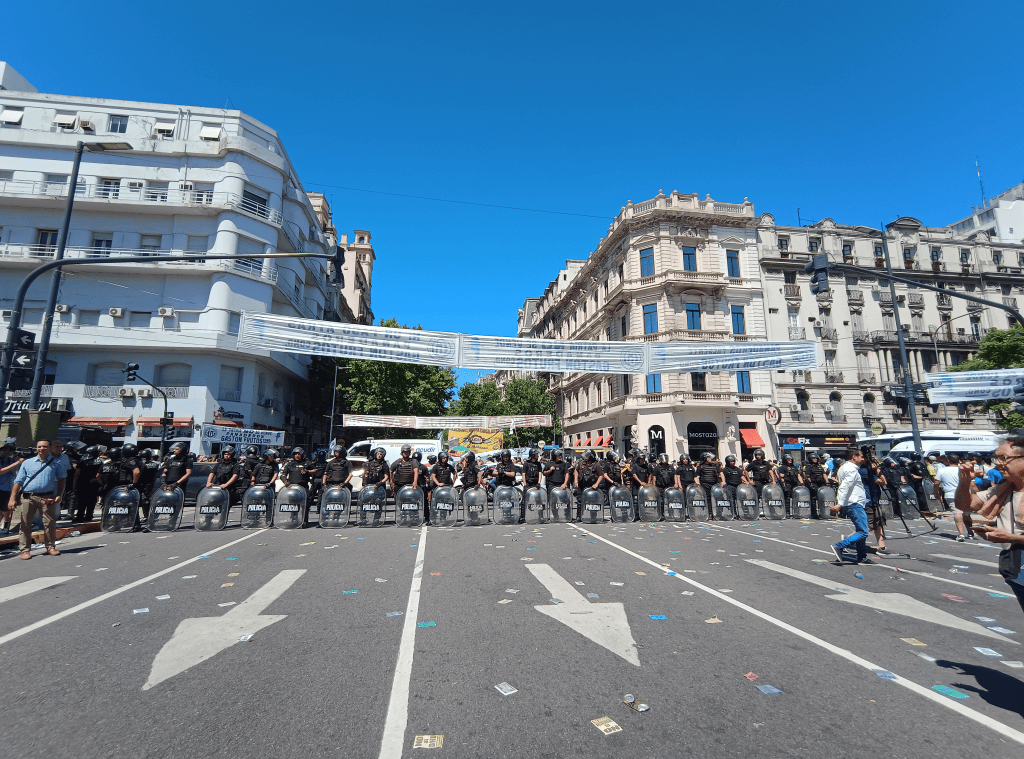
January 2024: Police form a barracade at one of the many protests against Milei’s policies (Image: Wikimedia Commons)
In June 2026, in the context of the Ni Una Menos march, the feminist movement issued a manifesto denouncing “the cruelty inflicted on our bodies and territories” and against “all forms of subjugation, exploitation and violence.”[30]
In late September 2026, the government of Buenos Aires attempted to withhold the permits needed for the Marcha del Orgullo (Pride Parade), scheduled for November 7. LGBTQ+ organisations rejected the measure and published an open letter affirming that the march would go ahead. The 35th edition of the LGBTQ+ Pride Parade will carry the slogan “Cuando el odio avanza, el Orgullo en las calles es resistencia” – “When hate advances, Pride in the streets is resistance” – a clear reference to the current context of democratic backsliding, intolerance, and the erosion of LGBTQ+ rights.[31]
Also in September 2026, a national protest, La Marcha de La Bronca – The March of Anger – brought people from all over the country out into the streets, demonstrating the effervescence of social protest and the rejection of Milei’s policies.[32]
The analysis of this article shows how ideology materialises into concrete state decisions, and how the strategy of culture war, based on the construction of antagonists—in this case, gender ideology—is used to legitimise and shape the boundaries of political action. Despite the case of Argentina showing the effectiveness of this strategy, it also illustrates how political practice finds its boundaries within the limits of popular resistence.
Daniela Alday Rubio is a former MSc student in Latin American Studies at the University of Oxford.
[1] Gramsci Antonio, Selections from the Prison Notebooks (New York: International Publishers, 1971), 107.
[2] Milei Javier and Giacomini Diego, Libertad, libertad, libertad (Buenos Aires: Galerna, 2019), 9–10.
[3] Presidencia de la Nación, “Milei: ‘No estamos dispuestos a negociar nuestros valores éticos y morales,'” Argentina.gob.ar, 27 de agosto de 2026, https://www.argentina.gob.ar/noticias/milei-no-estamos-dispuestos-negociar-nuestros-valores-eticos-y-morales.
[4] Javier Milei, “Milei en Davos: el discurso completo,” discurso pronunciado en el Foro Económico Mundial, Davos, 23 de enero de 2025, transcripción publicada en El Grand Continent, 25 de enero de 2025, http://legrandcontinent.eu/es/2025/01/25/milei-en-davos-el-discurso-completo-2/
[5] Infobae, “Javier Milei se definió como ‘el topo dentro del Estado’: ‘Soy el que destruye el Estado desde adentro,'” 27 de enero de 2024, https://www.infobae.com/politica/2024/01/27/javier-milei-se-definio-como-un-topo-dentro-del-estado-soy-el-que-destruye-el-estado-desde-adentro/
[6] Alday Rubio Daniela, “From Ideology to Political Practice: Culture War as a Strategy of the Contemporary Far Right” (MSc diss., University of Oxford, 2026).
[7] Centro de Economía Política Argentina (CEPA), La ejecución presupuestaria de la Administración Pública Nacional (CEPA, 2026).
[8] Laclau Ernesto, On Populist Reason (London: Verso, 2005), 70–71.
[9] Laje Agustín, La batalla cultural: Reflexiones para una nueva derecha (Buenos Aires: Harper-Collins, 2022); Milei and Giacomini, Libertad, libertad, libertad, 12.
[10] Morán Faúndes, J. M. (2019). “The geopolitics of moral panic: The influence of Argentinian neo-conservatism in the genesis of the discourse of ‘gender ideology,'” International Sociology, 34(4), 402–417. https://doi.org/10.1177/0268580919856488.
[11] Milei Javier, discurso pronunciado en el Foro Económico Mundial, Davos, enero de 2024, citado en “Milei declaró como enemigos al feminismo, al ambientalismo y al sentido común,” Agencia Presentes, 17 de enero de 2024, https://agenciapresentes.org/2024/01/17/milei-declaro-como-enemigos-al-feminismo-al-ambientalismo-al-sentido-comun/.
[12] Laje Agustín and Márquez Nicolás, El libro negro de la nueva izquierda: Ideología de género o subversión cultural (Buenos Aires: Grupo Unión, 2016), 55.
[13] Milei Javier, “President Milei’s Speech at the Council of the Americas 2026,” Oficina del Presidente, YouTube video, streamed live August 20, 2026, 35:51, https://www.youtube.com/live/TzuhI6lW6KI?t=2151s.
[14] Milei Javier, entrevista con Esteban Trebucq, La Nación+, 2023.
[15] “El Gobierno oficializó el cierre del INADI,” Infobae, August 6, 2024, https://www.infobae.com/politica/2024/08/06/el-gobierno-oficializo-el-cierre-del-inadi/.
[16] “Argentina Was the Only UN Country to Vote Against a Resolution to Eliminate and Prevent Violence Against Women,” Infobae, November 14, 2024, https://www.infobae.com/politica/2024/11/14/argentina-fue-el-unico-pais-de-la-onu-que-voto-en-contra-de-una-resolucion-para-eliminar-y-prevenir-la-violencia-contra-las-mujeres/.
[17] “Argentina Joins the Geneva Consensus Against Abortion,” Efeminista, accessed September 23, 2026, https://efeminista.com/argentina-adhiere-consenso-ginebra-contra-aborto/.
[18] Amnesty International Argentina – Two Years into the Current Government, the Rollback of Women’s and Diversity Rights Deepens.” Amnesty International Argentina, December 2025. https://amnistia.org.ar/noticias/a-dos-anos-del-actual-gobierno-se-profundiza-el-retroceso-en-los-derechos-de-mujeres-y-diversidades.
[19] Ibid.
[20] Ibid.
[21] Centro de Economía Política Argentina (CEPA), “La ejecución presupuestaria de la Administración Pública Nacional: 1° semestre 2024,” (CEPA, 2024).
[22] Ibid.
[23] Saavedra, “Ni Una Menos. Origins and the Process in Argentina,” International Socialist League, June 5, 2025.
[24] Clarín, “En la previa del 8M, Javier Milei apuntó duramente contra la militancia a favor del aborto: ‘Asesinos de pañuelos verdes,'” March 6, 2024, https://www.clarin.com/politica/dura-frase-milei-militantes-favor-aborto-asesinos-panuelos-verdes_0_Tm4qmaZxFb.html.
[25] La diaria, “Milei dijo que el aborto es un ‘asesinato agravado por el vínculo,'” March 2024, https://ladiaria.com.uy/mundo/articulo/2024/3/milei-dijo-que-el-aborto-es-un-asesinato-agravado-por-el-vinculo/.
[26] Amnesty International Argentina, “Two Years into the Current Government.”
[27] Equipo Latinoamericano de Justicia y Género (ELA), En estado de alerta: Monitoreo de políticas contra la violencia en Argentina entre diciembre y mayo de 2024. Informe preliminar (Buenos Aires: ELA, 2024), https://ela.org.ar/wp-content/uploads/2024/05/En-estado-de-alerta.-Monitoreo-de-politicas-contra-la-violencia-en-Argentina-entre-diciembre-mayo-de-2024.-Informe-preliminar.-ELA.pdf
[28] Dirección Nacional de Población del RENAPER, dataset collection, datos.gob.ar, accessed September 25, 2026, https://datos.gob.ar/dataset?q=%22Direcci%C3%B3n+Nacional+de+Poblaci%C3%B3n+del+Renaper%22.
[29] Rueda, Alba, “Cátedra Abierta – Educación Sexual Integral – Diplo 2026,” (Videoconference, September 12, 2026), https://www.youtube.com/watch?v=BGNAPE0h5mk&t=4549s.
[30] “Ni Una Menos lanza un ‘grito de hartazgo’ contra los feminicidios y el ajuste en políticas de género de Milei,” El País, June 4, 2026, https://elpais.com/argentina/2026-06-03/ni-una-menos-lanza-un-grito-de-hartazgo-contra-los-feminicidios-y-el-ajuste-en-politicas-de-genero-de-milei.html
[31] “La Ciudad no autorizará la Marcha del Orgullo por la visita del Papa, pero las organizaciones ratificaron que la harán igual,” elDiarioAR, September 18, 2026,
[32] “La Marcha de la Bronca” (1970), by Pedro y Pablo, was a iconic protest anthem against Onganías’ dictatorship it was recently adopted for the September 2026 national protest. Avaliable at: https://www.youtube.com/watch?v=d9hp-Sj940E.


