
Many assume the geographic proximity between Latin America and the United States is the most important determinant of the region’s respective foreign policies; I refer to this belief as the proximity assumption. This assumption is supported by John Mearsheimer’s theory that great powers seek to achieve regional hegemony by shaping the behavior of neighboring states.[1] Additionally, Tom Long’s observation that there are four distinguishable tiers in U.S.-Latin American relations–whereby Washington’s influence correlates with how close a Latin American country is located to the United States–underscores the importance of proximity to foreign policy decision-making.[2] Accordingly, it is conceivable why some without the relevant area-expertise come to believe in the proximity assumption.
However, a careful reflection on the history of U.S.-Latin American relations reveals that Latin American states’ geographic proximity to the United States is, in fact, not the most important determinant of their respective foreign policies. In what follows, I argue the difference in the aims and successes of Latin American foreign policy across two distinct eras of Inter-American relations illustrates that the proximity assumption, although superficially convincing, is false.
Era One: 1823–1996
In fairness to the proximity assumption, the U.S. government has frequently leveraged its proximity–in concert with its asymmetric economic, military, and cultural power–to influence Latin American countries.[3] Two early examples are the Monroe Doctrine and the Roosevelt Corollary; the former declared the Western Hemisphere off-limits to extra-regional interference, and the latter authorized the United States–as a unilateral “international police power”–to intervene militarily in the domestic affairs of Latin American countries.[4] Both were largely successful in influencing the foreign policy of Latin American states. For example, after the Monroe Doctrine was issued, Cuban foreign policy adjusted to avoid certain treaty arrangements and major loans with European countries which Havana suspected could provoke an adverse U.S. response.[5] Similarly, after the Roosevelt Corollary was announced, Dominican foreign policy changed to secure U.S. approval in external financial negotiations to avoid renewed U.S. intervention.[6]
The actions of the U.S. government in Latin America during the Cold War also corroborate the proximity assumption. Long argues that “the high point of U.S. influence” in Latin America occurred during the Cold War, when the United States “exercised substantial influence” in the region.[7] Such influence is evidenced by the U.S.-supported coups d’état in Guatemala in 1954, Brazil in 1964, and Chile in 1973, in which democratically-elected presidents Jacobo Árbenz, João Goulart, and Salvador Allende were respectively removed from power.
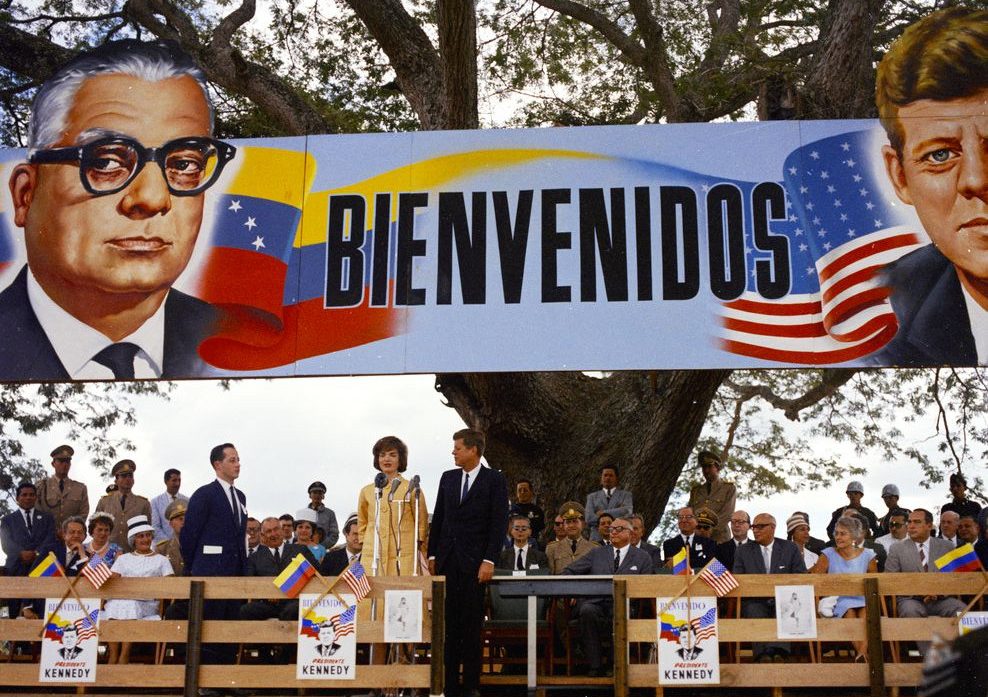
December 1961: John F. Kennedy warmly received in Venezuela (Image: Cecil Stoughton)
All the examples above–which albeit are far from constituting an exhaustive list of the interactions between the United States and Latin America during this era–clearly indicate that Washington largely constrained the foreign policies of Latin American countries. To be clear, the U.S. government unequivocally relied on its proximity with Latin American states to achieve such influence over their foreign policies. Additionally, and crucially, Washington was highly attentive to Latin America during this era, given that the United States government was concerned about European and Soviet intervention threatening U.S. national security.
Era Two: 2001–10
If the era above is defined by heightened U.S. attention and constrained Latin American foreign policy, this latter period should be characterized as the opposite. In this connection, Peter Smith notes that–following the September 11, 2001, attacks–the United States “focused its attention and energy on military campaigns in Afghanistan and Iraq” to advance the War on Terror, and thereby diverted its attention away from Latin America.[8] Smith further contends that “one of the most conspicuous features of U.S. diplomacy toward Latin America during the post-9/11 era was inattention,” and that such inattention “opened up surprising possibilities” for Latin American governments to pursue “a broad variety of (foreign) policy alternatives.”[9]
These alternatives include, but are not limited to, Venezuela launching the Bolivarian Alliance for the Peoples of Our America (“ALBA”), which has been explicitly framed as an alternative to the U.S.-promoted Free Trade Area of the Americas (“FTAA”). Additionally during this era, Mexico contributed to the creation of the Community of Latin American and Caribbean States (“CELAC”), which is a regional forum deliberately excluding the United States so that Latin American and Caribbean governments can coordinate policy among themselves without U.S. oversight. Smith contends that these initiatives, and others, were made possible because “the United States wasn’t paying attention” to Latin America.[10]
Additionally, while the U.S. government was preoccupied with the Middle East, China began significantly expanding its economic presence in Latin America. Juan Tokatlian correctly recognizes that China’s increasing economic presence in Latin America and Washington’s “distraction” with the War on Terror “coincided.”[11] Smith corroborates Tokatlian’s claim with trade data revealing that Latin American exports to China were $3.6 billion in 2000, then $18.6 billion in 2005, before reaching $72.8 billion in 2010.[12] Also in 2010, China purchased 10%, 15%, and 25% of the exports of Argentina, Brazil, and Chile, respectively.[13] Concurrently, “the United States was losing geoeconomic leverage” in Latin America, in that between 2000 and 2010, Washington’s share of exports declined by 24% to 12% in Bolivia, by 22% to 10% in Brazil, by 28% to 16% in Peru, and by 89% to 74% in Mexico.[14]
Synthesis
Based on the foregoing, it is evident that the proximity assumption is erroneous. Consider the two distinct eras discussed above, namely 1) the era delineated by the issuing of the Monroe Doctrine through the Cold War, and 2) the era beginning after the inception of the War on Terror. During the former era, the United States was largely successful in shaping the foreign policy of Latin American countries; additionally, Washington was highly attentive to Latin America during this era, given that the U.S. government was concerned about extra-hemispheric intervention threatening U.S. national security.
Conversely, after the War on Terror began, Latin American countries–including those in the uppermost tiers Long claims have the least ability to pursue foreign policies discordant with Washington’s interests[15]–pursued foreign policies which reduced U.S. influence; such foreign policies would have been virtually impossible to achieve during the first era. Additionally, these foreign policy strategies were pursued when Smith claims the most conspicuous feature of U.S. diplomacy at that time was inattention.[16]
Evidently, the degree to which the foreign policies of Latin American states were constrained by Washington varied considerably across these eras. Throughout each of these eras, however, geographic proximity remained constant. Therefore, proximity cannot be the variable that explains the difference in the aims and successes of Latin American states’ foreign policies across the eras. The most significant difference between these two eras is the intensity of Washington’s attention toward Latin America. Consequently, it is clear the most important determinant of the region’s foreign policies is not its proximity to the United States, given that Washington’s attention is more salient.
To be clear, I am not arguing that proximity has no influence on Latin American foreign policy. Due to Washington’s asymmetric economic, military, and cultural power, proximity to the United States unquestionably remains a significant determinant of Latin America’s respective foreign policies; this is evidenced by Latin American states’ longstanding general pattern of aligning their security, trade, and diplomatic initiatives with U.S. preferences, especially among countries geographically closest to the United States.
Proximity, however, operates more as a constant backdrop against which U.S. attention is the more salient influence on Latin American foreign policy decision-making. By recognizing the proximity assumption is false, and that Latin American foreign policy is not inherently constrained by Washington, scholars become more disposed to better understand the region’s autonomy, and more attentive to the factors which primarily influence Latin America’s foreign policies.
Ben Wardlow is an MPhil student in Global and Area Studies at the University of Oxford.
[1] Mearsheimer, John. The Tragedy of Great Power Politics (New York: W. W. Norton & Company, 2001), 41.
[2] Tom Long, “The United States in Latin America: Lasting Asymmetries, Waning Influence?” In External Powers in Latin America: Geopolitics between Neo-Extractivism and South-South Cooperation, edited by Gian Luca Gardini (London: Routledge, 2021), 3.
[3] Long, “The United States in Latin America,” 2.
[4] Theodore Roosevelt, “Fourth Annual Message to Congress,” December 6, 1904, Miller Center, https://millercenter.org/the-presidency/presidential-speeches/december-6-1904-fourth-annual-message.
[5] “The Platt Amendment,” 1901, National Archives, https://www.archives.gov/milestone-documents/platt-amendment.
[6] Abraham Lowenthal, The United States and the Dominican Republic to 1965: Background to Intervention, Caribbean Studies, vol. 10, no. 2 (1970), 4–6, 17.
[7] Long, “The United States in Latin America,” 6-7.
[8] Peter Smith. Talons of the Eagle: Latin America, the United States, and the World, 5th ed. (New York: Oxford University Press, 2022), 1.
[9] Ibid., 1, 22, 23.
[10] Ibid., 23.
[11] Juan Gabriel Tokatlian, “The State of US-Latin American Relations: The Case for a Diplomacy of Equidistance,” in Latin American Foreign Policies in the New World Order: The Active Non-Alignment Option, ed. Carlos Fortin et al. (London: Anthem Press, 2023), 6.
[12] Smith, Talons of the Eagle, 16.
[13] Ibid.
[14] Ibid., 21
[15] Long, “The United States in Latin America,” 3.
[16] Smith, Talons of the Eagle, 22.


