

At the United Nations General Assembly in September, Dominican President Luis Abinader called on the global community to address “a human tragedy without precedent” afflicting the only country bordering his own: Haiti. That same month, his government deported 34,873 Haitians and continued constructing a wall along the 236-mile border between the two countries sharing the Caribbean island of Hispaniola.
Gangs have seized 90% of Haiti’s capital city, terrorizing local communities. This insecurity has displaced more than 1.4 million, 10 percent of Haiti’s population, with more than 350,000 Haitians emigrating since 2024. As a new United Nations-backed anti-gang force arrived in Port Au-Prince in April, gangs massacred several dozen in a farming village previously considered safe.
Beside this crisis, the Dominican Republic has taken a two-sided approach to address the adjacent insecurity: attempting to stabilize the neighbouring country through diplomacy while expelling those fleeing the catastrophe.
A Tale of Two Countries
Dominican-Haitian tensions date back centuries. After freeing themselves from slavery and French colonialism, Haitian revolutionaries in 1822 invaded the adjacent former Spanish colony to consolidate their rule over the shared island. February 27, Dominican Independence Day, celebrates liberation not from Spanish colonialism but rather Haitian rule in 1844. Tensions peaked in 1937, when Dominican dictator Rafael Trujillo ordered the massacre of tens of thousands of Haitian sugarcane workers as part of his “anti-Haitianism” campaign. In the late 20th century, the Dominican Republic enjoyed decades of stable politics and abundant revenue from tourism and remittances, while Haiti suffered from turbulent politics, rampant corruption, and entrenched poverty. Haitian governance crises triggered U.S.-led military interventions in 1994 and 2004. Between 1981 and 2005, the Dominican Republic’s poverty rate (population living on less than $1.25 a day) plummeted from 17 to 5 percent while Haiti’s rose from 55 to 58 percent.
This divergence widened after a 7.0-magnitude earthquake ravaged Haiti in 2010—killing more than 200,000, leveling entire neighborhoods, and costing an estimated $8 billion in damaged infrastructure. Already in the country was the United Nations Stabilization Mission in Haiti (MINUSTAH), a Brazil-led multinational force that arrived to establish a “secure and stable environment” in 2004 but left in 2017 amid scandals involving sexual abuse and cholera outbreaks. By then, more than 400,000 Haitians lived in the Dominican Republic, constituting more than 5 percent of its total population and 80 percent of its foreign-born residents. These migrants became a critical labor source for multiple sectors of the Dominican economy, especially agriculture, tourism, and construction, yet the vast majority lived undocumented without legal protections.
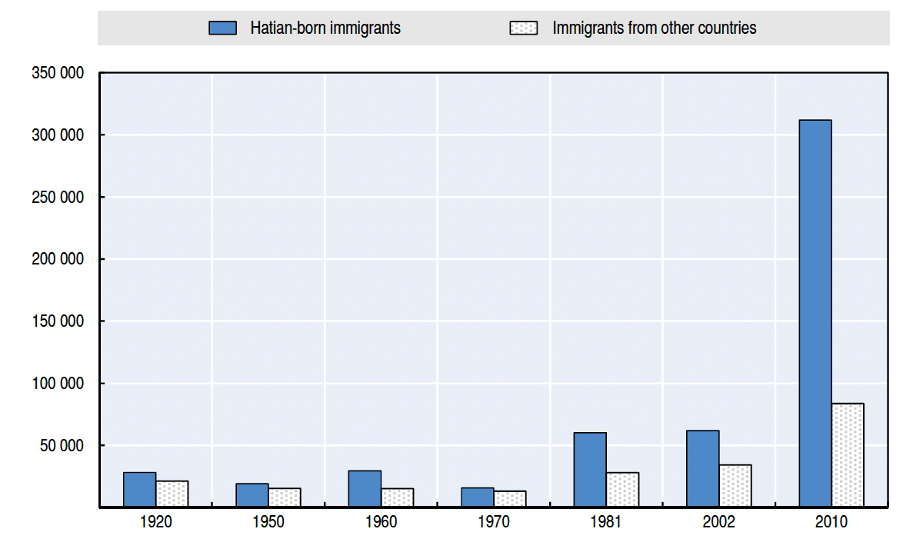
Haitian migrants in the Dominican Republic, 1920–2010 (Image: OECD)
Meanwhile, the Dominican government began militarizing border enforcement. In 2006, it established the Specialized Corps for Land Border Security (CESFRONT) to task military assets with border management. Admiral Sigfrido Pared Pérez, former Dominican Minister of Defence and General Director of Migration, explained in an interview with the author that CESFRONT utilizes “military units but with administrative capacities.” In 2012, the Dominican army deployed a “Secure Border Task Force” to monitor crossing points. Denaturalization scandals affecting Haitian-descendant Dominicans subsequently embroiled domestic politics. Yet the militarized approach, Pared Pérez explained, was so effective that Argentine, Chilean, and Peruvian officials visited to “learn about how to create border units.”
Two weeks after his September 2020 inauguration, Abinader was asked what his government would do for Haitians. “My government will be for Dominicans,” he responded. “What we are going to do is enforce the law—the migration law—as any country, as the United States, as Mexico, as any organized society enforces it.”
Looking Abroad for Help Next Door
As Abinader took office, Haiti spiraled. In July 2021, mercenaries assassinated President Jovenel Moïse. Unelected councils have nominally governed since while gangs have taken over the capital city, menacing local populations with extortion and brutal violence.
In October 2023, the UN Security Council (UNSC) authorized a multilateral force to bolster Haitian police’s fight against gangs. Led by Kenyan troops—and supported with Jamaican, Bahamian, Belizean, Guatemalan, and Salvadoran personnel and mostly U.S. and Canadian funds—the Multinational Security Support (MSS) mission has failed to curb the proliferating violence.
Abinader’s government has stated it cannot confront this neighbouring crisis alone. In an interview in late 2023, Abinader expressed hope that the Kenya-led force “could bring peace” and remarked, “We cannot do more, because we are not a rich country.” He has secured commitments from Secretary of State Marco Rubio and the new U.S. Ambassador to the Dominican Republic, Leah Francis Campos, to help.
Abinader has also lobbied multilaterally. Addressing the UN in September, he stated that the MSS had “not achieved its objectives” and that his government was conducting a “continuous diplomatic offensive” for an “effective international response.” At the assembly, Abinader endorsed a U.S. and Panama-coauthored resolution to create a 5,550-strong “Gang Suppression Force” (GSF) to replace the MSS. Abinader also personally asked Xi Jinping and Vladimir Putin to sponsor the resolution, which passed with 12 votes in favor and China, Russia, and Pakistan abstaining.
International partners continue backing Abinader’s efforts. In January, the UNSC unanimously renewed a support office complementing the incoming GSF. Two weeks later, the U.S. chief of mission in Haiti told Senators that the U.S. would “advance our interests” and those of “our close ally, the Dominican Republic” by contributing resources—though not personnel—to the anti-gang force.
Abinader’s government is also contributing, providing facilities for medical evacuations from Haiti. The first troops of the revamped force deployed from Chad in February. The UN has pledged to have full numbers by the fall.
Dominican Domestic Politics
Abinader’s strategy also carries a domestic component: deterring migration.
Like Trump’s first term, Abinader in 2021 announced the construction of a border wall with radars, facial-recognition cameras, and infrared rays. Two years later, he closed all land, air, and sea borders with Haiti and cancelled all Haitian visa applications.
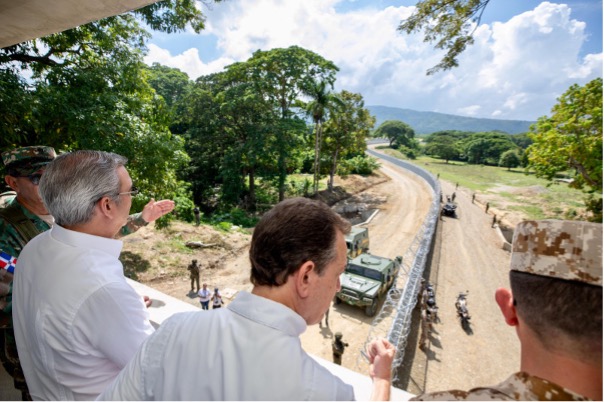
Abinader receives a briefing from a military official overlooking the new border wall dividing Haiti and the Dominican Republic (Image: Listin Diario)
Like Trump’s second term, Abinader’s immigration agenda has included mass deportations, with the General Directorate of Migration (DGM), the Dominican army, and national police all detaining migrants.
Last April, Abinader unveiled 15 new policies—including deporting individuals from hospitals. Facing outcry for expelling pregnant Haitian women, the DGM Director defended the policies, stating that Haiti imposed “increasing pressures on education, health, and informal employment” and noting 1,177,813 foreigners deported since 2016. These policies also generated criticism from the UN and human rights organizations for racial profiling and deporting individuals to extremely insecure areas. And they have generated fear in Haitian migrants at risk of deportation. A migrant living in a batey, the name for informal Haitian settlements in Dominican territory, explained that after authorities seized her son, “I felt like part of my heart was torn away. I wanted to go look for my son but couldn’t because if I had gone, they would have taken me too.”
Nevertheless, Abinader’s policies appear popular. Polls show 64% of Dominicans oppose rising Haitian migration. Some Dominicans have held anti-migrant rallies, at times violently. “Them there, us here”; “We don’t want Haitians here, let them go back to Haiti”; and “Country or death” were chanted at one such demonstration in November 2024. Abinader won re-election that month by 32 points. 88% of voters support his border wall, now the second-longest in the Americas.
But despite the hardline approach, cross-border flows continue. Holding a massive trade surplus with Haiti, the Dominican Republic exported over $700 million there last year. The border has proved porous as officials have permitted crossing for bribes. Nearly 300,000 Haitians work in the Dominican Republic, including 70,000 in the lucrative tourism sector.
Meanwhile, Dominican authorities continue daily raids on Haitian migrants, with more than 67,000 already deported this year.
Although lobbying for and contributing to a greater multilateral response, Abinader’s border policies demonstrate the limits of Dominican willingness to solve Haitian problems. Successful or not, Haiti’s new anti-gang force is unlikely to change the disposition next door. But perhaps it can on the world stage. Said UN Secretary General António Guterres following his visit to Haiti last week, “For the first time in many years, there’s finally some light at the end of the tunnel. Haiti has a chance to turn a corner — but only if the international community assumes its responsibilities… The biggest disgrace is indifference, the indifference of a world that has looked away.”
Looking globally, the Dominican experience—though tied to history dating to the 19th century—is part of rising international tensions surrounding migration. While attention has fixated Trump’s deportation raids and European alt-right parties, Haiti’s crisis has created some of the most notable political ramifications of cross-border migrant flows, spurring domestic hardline policies and greater diplomatic activity from its only bordering country. Although the Dominican Republic is geographically unique as one of two countries sharing an island, its experience navigating the neighboring crisis demonstrates how multilateral engagement, not just anti-migrant policies, can be sound policy for addressing human tragedies driving mass migration.
Henry Large is a doctoral candidate in Latin American Studies at the University of Oxford.

